You’ll need an Epiphany to figure out this one.
Shakespeare gives us a mature comedy that seems to have been randomly titled: Twelfth Night, or What You Will (i.e. whatever). A lady falls in love with a young guy who is really a woman in love with a guy who loves that lady from the start of this sentence. Drunken antics, practical jokes that get mean, and dismal songs push this play to the outer edge of comedy any maybe beyond. After the extended Christmas season of fun, it’s time to get back to the real world. But wait, there may be more of an epiphany here….
The alternate title, “What You Will,” translates fairly well into the modern idiom as “Whatever.” This is fortunate because, lord knows, the notion of Twelfth Night seems to have little if anything to do with the play. Speculation has pointed to January 6th (the twelfth day of Christmas) indicating a “topsy-turvydom” of indulgent festivities (Wells 177), a revelry signifying the end of the holiday season. Even the subtitle “speaks both to this customary season of topsy-turvy revelry and to the space of fantasy and wish-fulfillment that was the early modern playhouse” (Garber 506). The play seems to designate an end of comedy or a farewell to wit of this sort in the artistic development of the playwright — his efforts will focus on tragedies next (Goddard, I 295, 306). Or perhaps the play was designed for a particular occasion coinciding with Twelfth Night (Stratfordians say in 1601). Twelfth Night is also called the Epiphany — and we may need one to grasp the underlying meaning in this play.
Although orthodoxy wants to insist that a key source for the play is Barnaby Riche’s tale of “Apollonius and Silla” in Farewell to a Militarie Profession (Wells 182), they’ve got this backwards.
It so happens that Barnabe Riche is the last person Oxford would have derived anything from, even if he had had need of poaching and had not written his play at least a year earlier; for in this same book Riche had lampooned Oxford, at a time when the Earl’s fortunes were very low; and besides, Christopher Hatton was Barnabe Riche’s patron! Moreover, Riche stated on page 1 of his “Conclusion,” that some of the stories he used had already “been applied to the purposes of the stage.” (Ogburn and Ogburn 294)
In 1732, Francis Peck in Desiderata Curiosa noted plans to publish “a pleasant conceit of Vere, Earl of Oxford, discontented at the rising of a mean gentleman in the English Court, circa 1580” (qtd. in Clark 364; Ogburn and Ogburn 267; Anderson 154; Farina 82), and this is taken by Oxfordians to be a reference to an early now lost version of Twelfth Night and part of Oxford’s rivalry with Sir Christopher Hatton. The actual main source is Piccolomini’s 16th-century commedia erudite from Siena, Gl’Ingannati (The Deceived), involving brother/sister twins (Anderson 102-103) and its prefatory story, Il Sacrificio,featuring the character Agnol Malevolti (Ogburn and Ogburn 268), which Oxford may have seen performed in Siena during Twelfth Night in 1576 with the “mock sacrificial homage to the spear-shaker goddess Minerva that was an integral part of this entertainment” (Farina 83). Clear evidence of later revision — the elder Ogburns think in 1587 and a bit again very late (Ogburn and Ogburn 266) — includes the shifting function of Viola at Orsino’s estate, assignment of the music, and the superfluous Fabian who seems largely eclipsed by Feste but not eradicated entirely. A sketch of The Swan theater in 1596 by DeWitt may be depicting a scene from Twelfth Night, obviously earlier than orthodoxy assumes the play was written (Clark 377-378). The two ships named in the play — the Tiger and the Phoenix — were “particularly active” about 1580 (Clark 379). King Sebastian of Portugal died in 1578 and Antonio, natural son of John II of Portugal, claimed the throne. Antonio received aid from England against Spain (Clark 381). Spanish and Italian prisoners brought to England in 1579 included a Sebastian, an Antonio, and a couple Fabians (Clark 381). 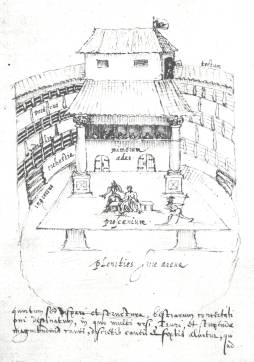
I’ve seen an attempt to translate the subtitle “What You Will” into the French “Comme Tu Veux” — sounding a bit like Comte (Count = Earl) de Ver. But I don’t know about this one. The Winter’s Tale is more convincing.
Perhaps Shakespeare pilfered from himself and his successes in the previous comedies for the combination of elements here (Goddard, I 294). But some other question (about identity? human interaction? the “will” of “What You Will”?) seems to be explored too in a new way. What would you say the world of Illyria represents? What is peculiar about the way everyone behaves, or runs their lives, in Illyria?
Twelfth Night, Act by Act
Twelfth Night Intro
Further Resources
Filmography
Twelfth Night. Vitagraph, 1910. Silent, one reel (12 minutes). Shakespeare without all those annoying words.
Twelfth Night. BBC, 1980.
Twelfth Night. Dir. Kenneth Branagh. Thames Television Ltd., 1988.
Twelfth Night. Dir. Trevor Nunn. Starring Helena Bonham Carter, Ben Kingsley. Summit Entertainment Films, 1996.
For a surprisingly insightful film-related web site on the 1996 Renaissance Films production of Twelfth Night, check out this.
She’s the Man. Starring Amanda Bynes. DreamWorks Pictures, 2006.
Twelfth Night. Starring Mark Rylance, Stephen Fry. Shakespeare Globe, 2012. An all-male live performance.
Best Editions
Bevington, David, ed. The Complete Works of Shakespeare. 6th ed. Pearson Education Inc., 2009. 333-369.
Brooks Harold F., ed. Twelfth Night. The Arden Shakespeare. 3rd Series. NY: Bloomsbury, 1979; rpt. 2013.
Delahoyde, Michael, ed. Twelfth Night. The Oxfordian Shakespeare Series, 2021.
Elam, Keir, ed. Twelfth Night. The Arden Shakespeare. 3rd edition. Methuen Drama, 2008.
Furness, Horace Howard, ed. Twelfth Night, or What You Will. A New Variorum Edition. Vol. 13. Philadelphia: J.B. Lippincott Co., 1901. NY: Dover Pub. Inc., 1964.
Weller, Philip, ed. Twelfth Night. An annotated online edition.
Oxfordian Resources
Clark, Eva Turner. Hidden Allusions in Shakespeare’s Plays. 3rd ed. by Ruth Loyd Miller. Port Washington: Kennikat Press, 1974. 364-381.
Farina, William. De Vere as Shakespeare: An Oxfordian Reading of the Canon. Jefferson, NC: McFarland and Co., 2006. 82-87.
Münnichow, Jens. “The Fool, the Monk and the Courtier: A Textual Connection of Shakespeare’s Twelfth Night to Baldassare Castiglione’s Masterpiece.” The Shakespeare Oxford Newsletter 61.2 (Spring 2025): 17-19.
Ogburn, Charlton. The Mysterious William Shakespeare: The Myth & The Reality. 2nd ed. McLean, VA: EPM Publications, Inc., 1992.
Ogburn, Dorothy and Charlton Ogburn. This Star of England. Westport, CT: Greenwood Press, Pub., 1952. 266-280.
Peel, Marion. “Twelfth Night, or what you will.” In Dating Shakespeare’s Plays. Ed. Kevin Gilvary. Tunbridge Wells, UK: Parapress, 2010. 167-176.
And Other General Resources
Asimov, Isaac. Asimov’s Guide to Shakespeare. NY: Gramercy Books, 1970. 575-594.
Bloom, Harold. Shakespeare: The Invention of the Human.NY: Riverhead Books, 1998. 226-248.
Garber, Marjorie. Shakespeare After All. NY: Pantheon Books, 2004. 506-535.
Goddard, Harold C. The Meaning of Shakespeare. Vol. 1. Chicago: The University of Chicago Press, 1951. 294-306.
Smidt, Kristian. Unconformities in Shakespeare’s Later Comedies. London: Macmillan Press Ltd., 1993. 120-140. Smidt finds numerous time discrepancies suggesting significant revision.
Shakespeare Authorship Organizations
The Shakespeare Oxford Fellowship. Browse, get hooked, become a member.
The De Vere Society. Our Oxfordian friends and collaborators across the pond.
The Shakespeare Authorship Roundtable. We consider all possible authors behind the “Shakespeare” name.
The Shakespeare Foundation. You say you want a revolution.