Being stripped of power and locked up in jail actually can help a narcissistic tyrant appreciate matters much better.
First, Richard II was Chaucer’s king for nearly all of that poet’s career(s), and Richard’s uncle, John of Gaunt, was Chaucer’s patron, friend, and brother-in-law. Shakespeare loves Chaucer (how can one not?), and this play is filled with the … absence of Chaucer. Although Chaucer is never mentioned even, it seems, obliquely, Shakespeare infuses this play with his spirit (and the word “pilgrimage”). For the real story of Richard II and his deposition by the Henry IV regime, read Terry Jones’ Who Murdered Chaucer?. And for my detection of subliminal Chaucer in this play and in Henry IV, Part 1, watch this.
Richard II is a stylized tragedy of a young eloquent king, perhaps “hopelessly miscast for the role of king” (Goddard, I 149), betrayed by supporters, compelled into resigning the crown, humiliated, imprisoned, and murdered. It’s “the dethronement of an unsuitable anointed monarch by an illegitimate but more able one” (Forker 1). It would have been awkwardly topical at the time, concerned with issues of what it means to be king and the plight of a country weakly governed. Queen “Elizabeth was sometimes accused of being over-influenced by favourites, and for this reason was compared with Richard II” (Wells 134); “the Queen was unusually susceptible to flattery and … favourites such as Leicester and Burghley were able to exert dangerous and harmful control over her policies” (Forker 5). Leicester and Burghley were the biggest thieves of Oxford’s properties.
Richard’s haughtiness and involvement in the dark dealings may also relate to Elizabeth: “Her own complicity in the execution of Mary, Queen of Scots, in 1587 was masked by a show of political indifference, like that of Bolingbroke toward Richard in this play” (Garber 239). When Elizabeth passed the age of breeding, the succession became an even more tense concern. And in any case, Elizabeth was the great-great-great-great-granddaughter of John of Gaunt (Asimov, II 262).
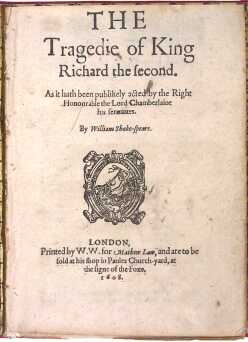
After an anonymous 1597 quarto edition came a 1598 edition designated as “By William Shake-speare” — with the hyphen (Ogburn and Ogburn 1228, Farina 110). Then appeared another 1598 quarto, a 1608 quarto (the first with the deposition scene, and a 1615 quarto, all before the First Folio (Gilvary 211-212).
Tellingly, the abdication (or deposition) scene does not appear in the first several quarto editions, so the touchy bit is not in print during Elizabeth’s lifetime: “where did it come from? Was it found among Lord Oxford’s papers? Had he left instructions that it should be added after the Queen’s death and his own?” (Ogburn and Ogburn 441). Even without the actual deposition scene, “We may be sure there was no common citizen in England who could have written this play at any time during Elizabeth’s reign, and lived” (Ogburn and Ogburn 430). After all, John Hayward wrote The Life and Reign of Henry IV in 1599, a tract that “not too subtly drew parallels between the corruption and misgovernment in Richard II’s court and the abuses of Elizabeth’s” (Anderson 330-331). “Queen Elizabeth saw Hayward’s book as incitement to revolution” (Anderson 331). He was tried for treason in 1600. Other tracts warned Elizabeth to beware the fates of Edward II, Richard II, and Henry VI (Forker 6).
Perhaps this play is most famous for being performed on the eve of the Essex “Rebellion” in February 1601. And it is the one referred to when Elizabeth exasperatedly remarked to William Lambarde, “I am Richard the Second, know ye not that?” (Ogburn and Ogburn 429; Garber 239; Anderson 331; Farina 111, Gilvary 215). But if originating much earlier, as is likely, the play may have functioned as a more pointed warning to Elizabeth than the Henry VI plays had been (Ogburn and Ogburn 429). By the way, Lambarde was presenting to Elizabeth his digest of historical records stored in the Tower (Forker 14).
E.T. Clark dates the composition at 1582, during a period of banishment from the court in which Oxford, “while still suffering under the displeasure of the Queen,” felt compelled to warn Elizabeth of the conspiracy of the Howards (her kinsmen) and that anti-Protestant faction (Clark 491-493), “lest she, too, might lose her throne and, perhaps, her life” (Clark 501). The euphuistic traces in the play further confirm an early 1580s origin (Ogburn and Ogburn 397). The elder Ogburns think the play was revised late in Oxford’s life at which time Richard II came to depict Southampton (Ogburn and Ogburn 867).
Richard II begins in medias res, which supports the idea that the anonymous Thomas of Woodstock may indeed be considered Richard II, Part 1 (Gilvary 215), covering events leading to the problem with which Richard II begins. Detection of extensive passages in rhymed couplets being inferior to much of the blank verse suggests different phases of composition: “it cannot be ruled out that Shakespeare himself wrote a tragedy in rhyme at some early date and later revised it in its extant form” (Smidt 87). Shakespeare scholars Tillyard and J. Dover Wilson also say we have a revision (Gilvary 214).
Shakespeare leaves out all mention of Robert de Vere, the 9th Earl of Oxford, who, “was King Richard’s best friend and worst influence” (Farina 112; cf. Ogburn and Ogburn 438-439). Nor is he mentioned in Woodstock (Gilvary 220). This de Vere served as Lord Great Chamberlain at the coronation of an 11-year-old Richard in 1377. De Vere was made Duke of Ireland (Clark 492), but eventually he was banished by Parliament as a corrupting influence on the king. Surely, Oxford “wanted to blot out the memory of his most infamous ancestor” (Farina 113). Robert de Vere died in exile in France, gored to death by a wild boar (Ogburn and Ogburn 29).
“It is a play in which remarkably little happens; there are no battle scenes, no severed heads, only one scene of violence” (Wells 133); a tournament is called off, and it’s said that one cannot even pinpoint the moment of Richard’s yielding the crown to Bolingbroke. So even though action and place are compressed ahistorically, very little happens in terms of drama. Instead the focus is on the poetry. This is the most lyrical of the history plays (like Romeo and Juliet in the tragedies and A Midsummer Night’s Dream in the comedies). This play sports the highest average length of speech (which can be irksome) and is probably the last to be written entirely in verse. Richard is eloquent — but what does that have to do with being king?
Richard is tragically passive, “a bad king and an interesting metaphysical poet; his two roles are antithetical, so that his kingship diminishes even as his poetry improves” (Bloom 249). But even his poetry lacks range, typically addressing only his own miseries. Richard is an inadequate human being who probably never really wins our sympathy entirely. He is unforgivably callous about his uncle’s death, so we have trouble suffering with him later, but he may win our reluctant aesthetic admiration. Late in the play when he can no longer give public speeches, he meditates on his true self and becomes a bit of a tragic hero with a new toughness emerging from his identity having been stripped away. And Bolingbroke becomes at least somewhat detestable.
Richard the Second, Act by Act
Richard the Second Intro
Further Resources
Filmography
Richard II. Starring Ian McKellan. Prospect Theatre Company, 1971. The entire play is here.
Richard II. Starring Derek Jacobi, John Gielgud. BBC, 1978.
King Richard II. Starring David Birney. Kultur, 1982. (Married to Meredith Baxter-Birney, we used to dub him Bernie Baxter-Birney in grad school, because we were wise-asses.)
The Hollow Crown. Starring Ben Whishaw, Patrick Stewart, David Suchet. Neal Street Productions, 2012. John of Gaunt’s famous speech is here.
Richard II. Starring David Tennant. Royal Shakespeare Company, 2013. The entire play is here. Jane Lapotaire as the Duchess of Gloucester.
Best Editions
Bevington, David, ed. The Complete Works of Shakespeare. 6th ed. Pearson Education Inc., 2009. 740-783.
Forker, Charles R., ed. Richard the Second. The Arden Shakespeare. 3rd Series. 2002.
Furness, Horace Howard, ed. The Life and Death of Richard the Second. A New Variorum Edition. Vol. 27. Philadelphia: J.B. Lippincott Co., 1955.
Oxfordian Resources
Clark, Eva Turner. Hidden Allusions in Shakespeare’s Plays. 3rd ed. by Ruth Loyd Miller. Port Washington: Kennikat Press, 1974. 491-507.
Delahoyde, Michael. “Subliminal Chaucer in Shakespere’s History Plays.” The Oxfordian 17 (2015): 153-162. Here.
Farina, William. De Vere as Shakespeare: An Oxfordian Reading of the Canon. Jefferson, NC: McFarland and Co., 2006. 110-114.
Gilvary, Kevin. Dating Shakespeare’s Play’s. Tunbridge Wells, UK: Parapress, 2010. 211-222.
Ogburn, Charlton. The Mysterious William Shakespeare: The Myth & The Reality. 2nd ed. McLean, VA: EPM Publications, Inc., 1992.
Ogburn, Dorothy and Charlton Ogburn. This Star of England. Westport, CT: Greenwood Press, Pub., 1952. Esp. 428-443.
And Other General Resources
Asimov, Isaac. Asimov’s Guide to Shakespeare. Vol. 2. NY: Gramercy Books, 1970. 253-314.
Bevan, Bryan. King Richard II. London: The Rubicon Press, 1990. Rpt. 1996. A historical biography.
Bloom, Harold. Shakespeare: The Invention of the Human.NY: Riverhead Books, 1998. 249-270.
Forker, Charles R. Introduction. King Richard II. The Arden Shakespeare. 3rd Series. 2002. Even among (albeit Stratfordian) Arden editors’ commentaries, this one is thoroughly brilliant.
Garber, Marjorie. Shakespeare After All. NY: Pantheon Books, 2004. 238-269.
Goddard, Harold C. The Meaning of Shakespeare. Vol. 1. Chicago: The University of Chicago Press, 1951. 148-160.
Jones, Terry. Who Murdered Chaucer? NY: Thomas Dunne Books, 2003. The Monty Python alum is a medieval expert with a disturbing and dark theory as to what happened to Chaucer, the supreme Ricardian poet whom Shakespeare weirdly never mentions.
Saul, Nigel. Richard II. New Haven: Yale University Press, 1997. A historical biography.
Smidt, Kristian. Unconformities in Shakespeare’s History Plays. NJ: Humanities Press, 1982. 86-102. Smidt finds numerous time discrepancies suggesting significant revision, compression, and rearrangement of scenes.
Wells, Stanley. Shakespeare: A Life in Drama. NY: W.W. Norton & Company, 1995. 132-140.
Shakespeare Authorship Organizations
The Shakespeare Foundation. Dir. Alan W. Green. The sponsor of Shakespeare Illuminated. You say you want a revolution. Well….
The Shakespeare Oxford Fellowship. Browse, get hooked, become a member.
The De Vere Society. Our Oxfordian friends and collaborators across the pond.
The Shakespeare Authorship Roundtable. We consider all possible authors behind the “Shakespeare” name.