Stratfordians date this play from the spring of 1599, just before publication of a “newly corrected” edition with the hyphenated Shake-speare name on it (Ogburn and Ogburn 1039), and based on a topical interpretation in the Chorus in Act V (the General = Essex; the Empress = Elizabeth, who had sent him on an Irish campaign). But Oxfordians have pointed out how little sense that allusion would make and instead propose a composition in the early- or mid-1580s (e.g., Ogburn and Ogburn 710) and the reference being to Thomas Butler, Elizabeth’s commanding general in Ireland. According to J.Q. Adams, there was a Henry V play before 1588 at the Bull in Bishopsgate (Ogburn and Ogburn 729; Jiménez, “‘Rebellion'”).
The main reasons for thinking that Shakespeare wrote the play titled The Famous Victories of Henry the Fifth in the 1570s and revised the play into the two Henry IV plays and Henry V are given by Ramón Jiménez, “The Famous Victories.” The 11th Earl of Oxford, who plays so large a part in Famous Victories, has disappeared in favor of the glory going to the king; Shakespeare matured (Ogburn and Ogburn 29, 713). The secretaries and “University Wits” attached to Oxford may have added touches, but nothing like to the extent of 1 Henry VI (Ogburn and Ogburn 730). Holingshed’s Chronicles (1577), dedicated to Burghley, is Shakespeare’s other main source (Farina 126).
The First Quarto has 1,622 lines whereas the First Folio version has 3,381 (Gilvary 241). This is partly due to the fact that the Quarto has no Chorus, no Act III scene i (the Harfleur speech), no Act IV scene ii (the French arming), nor part of Act III scene ii (with the Scots Captain Jamy) — this last omission perhaps to avoid offending James, although that seems premature (Gilvary 243). “There is no reason to think that the choruses were part of the original version” (Smidt 132).
Despite the implications in the epilogue to Henry IV, Part 2, probably written in the planning stages of Henry V, Shakespeare changed his mind about continuing with the character of Falstaff. His presence would tend to undermine any seriousness. “Shake-speare, after stuffing his resurrected Lollard with his own inspired irreverence, re-dedicates him on the desperate altar of patriotism; all in the context of an Elizabethan John Wayne war movie” (Eldridge).
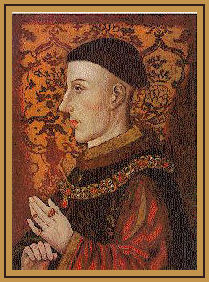
The historical Henry V was a national hero and successful warrior king against England’s traditional enemy, France. He was the strongest English king before Henry VIII. Henry ascended the throne at the age of 25 in 1413 and died in France at 35 probably of fever complicated with stomach trouble, and according to one account after infernal visitations and pangs of conscience (Goddard, I 247). His imperialist real estate grab did not last long after death under the weak monarch Henry VI.
The standard view is that the material for once was too much for Shakespeare. Military victory is epic, maybe lyrical, but not dramatic matter. “As a propaganda vehicle, the play was superlative, drawing upon ‘true events’ from the country’s past to dramatize how a ragtag, disparate group of people with little in common except one dread sovereign could still achieve a difficult objective, and do so against tremendously long odds” (Farina 126). While “A spirited and stirring piece of drum-beating and flag-waving,” it remains history instead of being transmuted into drama (Goddard, I 215). It can even be considered jingoistic (Asimov 450). On these terms, one must subscribe to militaristic values to like this play. Perhaps Prince Hal was “lovable”; but “King Henry is [at best] merely admirable and, at that, more admirable from a distance” (Asimov, II 449).
Yet Shakespeare, while loving England, as Bloom repeatedly reminds us, cared little for the State (which tortured Thomas Kyd, branded Jonson, and maybe murdered Marlowe). And this is the culminating masterpiece after a set of other historical successes. So a closer look is required, and it reveals a lot, indeed an entire reading which contradicts the standard view expressed even in Cliffs Notes and the 1944 Laurence Olivier film. “But grant that Henry is the golden casket of The Merchant of Venice, fairer to a superficial view than to a more searching perception, and instantly the play becomes pervaded with an irony that imparts dramatic value to practically every one of its main scenes” (Goddard, I 266).
Oxfordian perspectives include the notion that the play originally reflects events of 1586, such as the arrest of the Babington conspirators (Clark 772; Ogburn and Ogburn 729). The propagandistic features would have been particularly timely with war with Spain on the horizon for England, and Oxford’s 1586 annuity can be accounted for (Farina 128). Despite Elizabeth’s coffers having been drained for military expenses, the thousand-pound annuity to Oxford through Walsingham’s Secret Service Office (Clark 780) amounted to “Lord Oxford’s secret appointment to have been the first known Ministry for Propaganda” (Ogburn and Ogburn 710). Subsequently, the required anonymity: “as a propaganda piece, any play would have been more effective if credited to a commoner rather than to a royally subsidized nobleman” (Farina 126).
Shakespeare seems aesthetically defiant in the second tetralogy. In his Defense of Poetry, Sidney objects to “the compression of time and space itself … or continually shifting moods and settings without explaining each step to the audience” (Anderson 150). Shakespeare reacts to Sidney’s fit at the mixing of kings and clowns, comedy and tragedy, and also of expecting too much of audience (Gilvary 251): “De Vere shot back at Sidney in a Shake-spearean fashion. Shake-speare’s Henry V, the final draft of which was undoubtedly written years after the author’s personal quarrel with Sidney, contains a Chorus that apologizes for than thirty times for its regular shifting of time, mode, and setting. Whenever the play hops over the English Channel or otherwise requires the audience to exercise their imagination, the Chorus interjects a satirical note of explication for fussbudgets like Sidney who require everything to be laid out neatly” (Anderson 150-151; cf. Farina 127).
Several “structural anomalies” (Smidt 121) pointed out as they arise result from the fact that “The text of Henry V which was printed in 1623 was evidently to some extent a conflated version, containing passages from different stages of composition and revision, some of which had been meant for excision” (Smidt 132). For example, “If there were contradictions in the presentation of Harry in the two preceding histories, they are nothing to the schizophrenia we find in Henry V” (Smidt 141).
Henry V, Act by Act
Henry V Introduction
Further Resources
Filmography
Henry V.
Henry V.
Henry V.
The Hollow Crown. Starring Hiddleston. Neal Street Productions, 2012.
Best Editions
Bevington, David, ed. The Complete Works of Shakespeare. 6th ed. Pearson Education Inc., 2009. 873-918.
Craik, T.W., ed. King Henry V. The Arden Shakespeare. 3rd Series. Routledge, 1995.
Oxfordian Resources
Clark, Eva Turner. Hidden Allusions in Shakespeare’s Plays. 3rd ed. by Ruth Loyd Miller. Port Washington: Kennikat Press, 1974. 772-790.
Farina, William. De Vere as Shakespeare: An Oxfordian Reading of the Canon. Jefferson, NC: McFarland and Co., 2006. 125-130.
Gilvary, Kevin. Dating Shakespeare’s Play’s. Tunbridge Wells, UK: Parapress, 2010. 241-253.
Jiménez, Ramón. “The Famous Victories of Henry the Fifth: Key to the Authorship Question?” The Shakespeare Oxford Newsletter 37.2 (Summer 2001): 7-10.
Jiménez, Ramón. “‘Rebellion broachèd on his sword’: New Evidence of an Early Date for Henry V.” The Shakespeare Oxford Newsletter 37.3 (Fall 2001): 8-11, 21.
Ogburn, Charlton. The Mysterious William Shakespeare: The Myth & The Reality. 2nd ed. McLean, VA: EPM Publications, Inc., 1992.
Ogburn, Dorothy and Charlton Ogburn. This Star of England. Westport, CT: Greenwood Press, Pub., 1952. Esp. 730-738.
And Other General Resources
Goddard, Harold C. The Meaning of Shakespeare. Vol. 1. Chicago: The University of Chicago Press, 1951. 215-268.
Smidt, Kristian. Unconformities in Shakespeare’s Tragedies. NY: St. Martin’s Press, 1990. 121-144. Smidt finds numerous time discrepancies suggesting significant revision, compression, and rearrangement of scenes.
Shakespeare Authorship Organizations
The Shakespeare Oxford Fellowship. Browse, get hooked, become a member.
The De Vere Society. Our Oxfordian friends and collaborators across the pond.
The Shakespeare Authorship Roundtable. We consider all possible authors behind the “Shakespeare” name.