So how’s that whole usurpation thing going, and where’s that oldest son of yours?
For the real story of Henry’s deposing of Richard II and the nasty consequences of the regime change, read Terry Jones’ Who Murdered Chaucer?. And for my detection of subliminal Chaucer in this play and in Richard II, watch this.
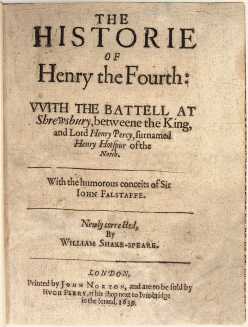
Traditional dating of this play is about 1596, for what that’s worth. (Nothing.) The First Quarto was published anonymously in 1598, was included in Meres’ list of Shakespeare plays; and then was printed as another Quarto in 1599, “Newly corrected by W. Shake-speare” (Farina 115, Ogburn and Ogburn 1028).
The main reasons for thinking that Shakespeare wrote the source play also — the anonymous play titled The Famous Victories of Henry the Fifth — in the 1570s and revised it into the two Henry IV plays and Henry V in the 1580s, are given by Ramon Jiménez. The elder Ogburns earlier had made the same basic assertions (Ogburn and Ogburn 710; cf. Farina 116). The second edition of Holinshed’s Chronicles (1587) is also considered a main source by orthodox Shakespeareans (Farina 116, Gilvary 223).
Shakespeare’s
imagination seems to play even more creatively over the matter of history, with less didacticism and greater artistic freedom. If in Richard the Second he seems deliberately to have been limiting his stylistic range, in Henry the Fourth, Part One and its successors he revels in his command of a wide range of styles in both verse and prose and of the opportunities it affords him for suggesting idiosyncrasy of character through language. (Wells 141)
The play opens in mid-1402, about two years after the end of Richard II, when the historical Henry was only 36 years old, though he did suffer from a chronic disease involving skin lesions which aged him — perhaps just psoriasis but which he took to be a divine punishment (Asimov, II 315). Additionally, Harry Percy, a.k.a. Hotspur, was two years older than king (Ogburn and Ogburn 715; Asimov, II 321) but is rendered an age-appropriate rival to Prince Hal. If Oxford was trying to portray his own enemy and contemporary Arundel, he would have found in history no young enemy to King Henry, hence the age manipulation (Clark 734).
Shakespeare’s mishmash of the history of the reign of King Henry IV … presents a compelling allegorical retelling of the civil war that Queen Elizabeth almost faced in 1569. The 1569 Northern Rebellion’s Bishop of Ross provides key inspiration for the charismatic religious leader, the Archbishop of York, who spurs the rebels on…. The nineteenth-century historian Richard Simpson concluded that the Henry IV plays depict the context of the Northern Rebellion so accurately that the author must have consulted with a firsthand observer. In fact, Simpson was half right. The author was a firsthand observer. (Anderson 44)
Oxford had gone to Scotland on a military expedition.
We have, then, a “weaving together of history and the present” (Beauclerk 219). In the sequence of the history, “the tone changes. While the desire for revenge remains — and with it the search for identity — it has found an outlet in art, imagination, and language…. Prince Hal wears the mask of the jester and joins Falstaff’s theatricals” (Beauclerk 227).
Although the historical role of the 11th Earl of Oxford had been amplified in Famous Victories to “advisor and principal lieutenant,” he is reduced in these revised plays (Ogburn and Ogburn 29), either because of the “maturing taste of the dramatist” beyond hero-worship (Clark 681), or, more likely, because of the secret service annuity granted to Oxford from 1586 onwards, the terms of which “had stipulated stringent anonymity” (Ogburn and Ogburn 713). The funds, we can assume, were intended “for the first organized propaganda. Oxford was to produce plays which would educate the English people — most of whom could not read — in their country’s history, in appreciation of its greatness, and of their own stake in its welfare” (Anderson 211).
Falstaff has been among the most celebrated of literary characters because his vitality almost gives him a life of his own. Others find him reprehensible. It probably depends on how one takes subversiveness. Originally this character was named after Protestant martyr Sir John Oldcastle — again from the source play, The Famous Victories, though a pun buried even in Henry IV, Part 1 survives (I.ii.40-41); and in Henry IV, Part 2 (I.ii), “Old” appears as a speech prefix (Gilvary 226). The historical Oldcastle — not fat nor old, and no more than ten years older than Prince Henry (Asimov, II 327) — was depicted as a patriotic war-hero in Bale’s Brief Chronicle (1544); but he was a Lollard, a follower of Wycliffe, had a falling out with the real King Henry V, became an outlaw, was captured, and slowly roasted to death in 1417, subsequently considered by some a Protestant martyr (Asimov, II 328; Farina 121). Although it is uncertain who demanded the change of name (Gilvary 227), Oldcastle’s descendant Lord Cobham, Lord Chamberlain from 1596 until his death in 1597, many identify as the one who objected to the portrayal as a reprobate (Asimov, II 329; Wells 140). So the name was changed: and note, Fal/staff – Shake/speare (e.g., Bloom 273).
A few Oxfordians sense the figure of Lord Burghley behind at least early stages in the evolution of this character. But some also think that de Vere packed on some noticeable weight when he was in his 40s, and certainly some features strike us as autobiographical: “I am not only witty in myself, but the cause that wit is in other men” (Henry IV, Part 2 I.ii.9-11). Additionally, Falstaff’s girth may be metaphoric or symbolic. More about Falstaff below.
In a sense, courtiers such as de Vere were the true impresarios of that time, being constantly “on stage” in the public eye. During his participation in the Royal Progress of 1580, de Vere, according to an eyewitness, incited laughter from the crowds by gesturing with his white staff of office. One can only imagine. Moreover, the very name of Falstaff suggests letting fall a staff representing a symbolic dignity. (Farina 123)
Henry IV, Part 1, Act by Act
Henry IV, Part 1 Introduction
Further Resources
Filmography
Henry IV, Part 1. A.k.a. An Age of Kings, Episodes 3 & 4. Starring Tom Fleming, Robert Hardy, Sean Connery. BBC, 1960. Full play here.
Chimes at Midnight. A.k.a. Falstaff. Dir. and Starring Orson Welles. 1965.
Henry IV, Part 1. BBC Television, 1979.
Henry IV, Part 1. Starring Michael Cronin. English Shakespeare Company, 1990. Full play here.
The Hollow Crown. Starring Jeremy Irons, Simon Russell Beale, Tom Hiddleston. Neal Street Productions, 2012.
Best Editions
Bevington, David, ed. The Complete Works of Shakespeare. 6th ed. Pearson Education Inc., 2009. 784-825.
Furness, Horace Howard, ed. Henry the Fourth, Part 1. A New Variorum Edition. Vol. 21. Philadelphia: J.B. Lippincott Co., 1936.
Kastan, David Scott, ed. King Henry IV, Part 1. The Arden Shakespeare. 3rd Series. Bloomsbury, 2002.
Oxfordian Resources
Clark, Eva Turner. Hidden Allusions in Shakespeare’s Plays. 3rd ed. by Ruth Loyd Miller. Port Washington: Kennikat Press, 1974. 680-705.
Delahoyde, Michael. “Subliminal Chaucer in Shakespere’s History Plays.” The Oxfordian 17 (2015): 153-162. Here.
Farina, William. De Vere as Shakespeare: An Oxfordian Reading of the Canon. Jefferson, NC: McFarland and Co., 2006. 115-119.
Gilvary, Kevin. Dating Shakespeare’s Play’s. Tunbridge Wells, UK: Parapress, 2010. 223-234.
Gontar, David P. “Extra Pointz.” In Hamlet Made Simple and Other Essays. Nashville: New English Review Press, 2013. 64-82.
Gontar, David P. “An Islamic Reading of King Henry IV.” In Hamlet Made Simple and Other Essays. Nashville: New English Review Press, 2013. 355-376.
Jiménez Ramón. “The Famous Victories of Henry the Fifth: Key to the Authorship Question?” The Shakespeare Oxford Newsletter 37.2 (Summer 2001): 7-10.
Jiménez Ramón. “‘Rebellion broachèd on his sword’: New Evidence of an Early Date for Henry V.” The Shakespeare Oxford Newsletter 37.3 (Fall 2001): 8-11, 21.
Münnichow, Jens. “Falstaff’s Fencing: Shakespeare’s Special Knowledge in Henry IV, Part 1.” Shakespeare Oxford Newsletter 62.1 (Winter 2026): .
Ogburn, Charlton. The Mysterious William Shakespeare: The Myth & The Reality. 2nd ed. McLean, VA: EPM Publications, Inc., 1992.
Ogburn, Dorothy and Charlton Ogburn. This Star of England. Westport, CT: Greenwood Press, Pub., 1952. Esp. 713-722.
And Other General Resources
Goddard, Harold C. The Meaning of Shakespeare. Vol. 1. Chicago: The University of Chicago Press, 1951. 161-214.
Smidt, Kristian. Unconformities in Shakespeare’s History Plays. NJ: Humanities Press, 1982. 103-120. Smidt finds numerous time discrepancies suggesting significant revision, compression, and rearrangement of scenes.
Shakespeare Authorship Organizations
The Shakespeare Oxford Fellowship. Browse, get hooked, become a member.
The De Vere Society. Our Oxfordian friends and collaborators across the pond.
The Shakespeare Authorship Roundtable. We consider all possible authors behind the “Shakespeare” name.