ACT II
SCENE i
Pompey speaks with his cronies about their challenge to the triumvirate, insisting that the gods are on his side: “If the great gods be just, they shall assist / The deeds of justest men.”
Menas assures him: “Know, worthy Pompey, / That what they do delay they not deny.” But Pompey replies, “Whiles we are suitors to their throne, decays / The thing we sue for” (II.i.1-4). Pompey’s despairing perspective includes language less evocative of gods and armies than of the Elizabethan royal court and her courtiers hoping for favors. His perspective is identical in sentiment both to a saying Hamlet mentions — “‘While the grass grows’ — the proverb is something musty” (III.ii.343-344) — and to a complaint Oxford expressed in a 1576 letter to his father-in-law Lord Burghley: “I am to content myself according to the English proverb that it is my hap to starve while the grass doth grow.” The proverb originally refers to a horse starving.
Menecrates tries to be philosophical:
We, ignorant of ourselves,
Beg often our own harms, which the wise pow’rs
Deny us for our good; so we find profit
By losing of our prayers. (II.i.5-8)
But Pompey is confident. “The people love me, and the sea is mine” (II.i.9). He is glad that “Mark Anthony / In Egypt sits at dinner, and will make / No wars without-doors” (II.i.11-13), and he considers Caesar an upstart, losing affection and loyalty while demanding monetary tribute. Lepidus is a waste of space.
Pompey hopes that Cleopatra will “Tie up the libertine in a field of feasts, / Keep his brain fuming” (II.i.23f). But news arrives that Anthony is due any moment back in Rome. At least, Pompey can rationalize, the threat he himself poses must be significant enough to “pluck” Anthony from “the lap of Egypt’s widow” (II.i.37). Menas reassures Pompey that Caesar and Anthony are probably antagonistic towards each other, but Pompey worries that they might patch up their differences in light of the greater danger.
SCENE ii
Lepidus hopes Anthony will act reverently to Caesar, but Enobarbus insists Anthony will not demean himself and will exert an appropriate defiance. Caesar enters with his officers Maecenas and Agrippa, and Lepidus continues trying to smooth matters over: “When we debate / Our trivial difference loud, we do commit / Murther in healing wounds” (I.ii.22-24) — a medical analogy for the occasion and possibly a Shakespearean international critique.
All is tense and political between Anthony and Caesar, even the etiquette of sitting down (II.ii.31ff). Anthony half-broaches the subject: “I learn you take things ill which are not so — / Or being, concern you not” (II.ii.34-35). Caesar thinks it laughable that he should care about Anthony’s life in Egypt, unless Anthony “Did practice on my state” (II.ii.44), that is, plot against him. Caesar is a hypocrite, as all this is not what he was kvetching with Lepidus about earlier. And he’s bitchy about the wars made upon him by Anthony’s wife and brother. Anthony insists that had nothing to do with him — on the contrary, part of their motivation was to get him back from Egypt (II.ii.99ff), after another seemingly extraneous reference in the play to “Three kings” (II.ii.81).
This scene of bickering egos has been called a clash between the power of personality and the impersonality of power (Goddard, II 185). Caesar trusts no one, which makes him politically successful; he’s inherited the canniness but not the generosity of his uncle and adoptive father, Julius Caesar.
Caesar is additionally pissed that Anthony didn’t supply troops when requested: Caesar says Anthony denied them; Anthony says neglected to send (II.ii.94). Both Lepidus and Enobarbus recommend that they suspend their petty grievances in light of the matter at hand, but Anthony tells Enobarbus (again) to shut up. Enobarbus’ ironic response — “That truth should be silent I had almost forgot” (II.ii.112) — cuts to the heart of the Shakespeare Authorship Question and what seems from the start, in the late sixteenth century, the enforced silence surrounding the Earl of Oxford. From Hamlet’s final words to Bottom’s self-censorship concerning his love-affair with the fairy-queen, Shakespeare is fixated on the disturbing tendency for authority to suppress truth, or as Shakespeare coins in Sonnet #66, “art made tongue-tied by authority.” Such a theme makes the best sense in the case of the true poet/playwright knowing that he will not receive credit for his work, due to whatever deal was struck with the Queen or, more viciously, with the Cecils. Shakespeare’s anticipation that “my name be buried” (Sonnet #72) is either the most extreme mistake he ever made — virtually everyone has at least heard of “Shakespeare” — or the Earl of Oxford’s dead-on horror.
Agrippa pipes in with a plan: what if Anthony, now that he’s a widower, were to marry Caesar’s sister Octavia? Caesar makes a snide comment about Cleopatra’s potential reaction to such a plan, prompting Anthony to assert his independence: “I am not married, Caesar” (II.ii.128). After a lengthy explanation of the advantages of this plan, Agrippa adds, “Pardon what I have spoke, / For ’tis a studied, not a present thought, / By duty ruminated” (II.ii.142-144) — an indication that this has been an artificial set-up, arranged ahead of time by Caesar to see Anthony’s reaction. It works; Anthony is agreeable. Caesar magnanimously states, “A sister I bequeath you, whom no brother / Did ever love so dearly” (II.ii.156-157), but although he objects to the idea of Anthony’s giving up a kingdom for a “whore,” he’s willing to fork over a sister for an empire (Goddard, II 186).
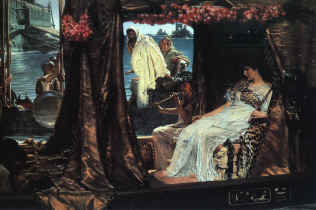
Anthony remarks that Pompey is not really his enemy, so perhaps some diplomacy will work. The triumvirs retire, matters having been “well disgested” (II.ii.182). The three officers remain behind: Enobarbus, Maecenas, and Agrippa, the latter two asking Enobarbus about the luxurious life in Egypt. The description scene of Cleopatra’s barge is taken very directly from Plutarch (or the translation) — practically prose rendered into blank verse. Enobarbus also recounts the meeting of Anthony and Cleopatra, involving the politics of food — who would come to whose supper. The blur between Cleopatra and her land emerges in a crude assertion by Agrippa: “She made great Caesar lay his sword to bed; / He ploughed her, and she cropp’d” (II.ii.231-232). But Enobarbus speaks of her enchanting qualities. Maecenas notes that “Now Anthony / Must leave her utterly” (II.ii.237), and we worry about Enobarbus’ diplomacy; perhaps his camaraderie goes too far in his predicting that Anthony will not leave Cleopatra:
Age cannot wither her, nor custom stale
Her infinite variety. Other women cloy
The appetites they feed, but she makes hungry
Where most she satisfies; for vildest things
Become themselves in her, that the holy priests
Bless her when she is riggish.
(II.ii.239-244)
[The first part of the quotation is paraphrased by Sherlock Holmes.]
SCENE iii
Anthony says to Octavia, “The world and my great office will sometimes / Divide me from your bosom” (II.iii.1-2). Even though his role as Lord Great Chamberlain held few real ceremonial obligations, much less official duties, Oxford’s status at the royal court in the 1570s as Elizabeth’s favorite did divide him from his wife Anne. It is speculated that this is why Elizabeth supported the marriage: that Anne being so young would not successfully put demands on the time of the Queen’s own favorite.
With Caesar chaperoning, Anthony tells Octavia also not to worry about his checkered past, that he’ll be true. “I have not kept my square, but that to come / Shall all be done by th’ rule” (II.iii.6-7): an architectural carpentry reference to Masonic matters.
But after a soothsayer tells Anthony that Caesar’s fortunes are better and that Anthony’s character withers in the presence of Caesar, an indication that he’s trying to align himself in the wrong world, Anthony “will to Egypt; / And though I make this marriage for my peace, / I’ th’ East my pleasure lies” (II.iii.38-40).
SCENE iv
Lepidus and the officers prepare for possible battle.
SCENE v
Cleopatra wants to play billiards, anachronistically, and, inspiring the opening lines of Twelfth Night, calls, “Give me some music; music, moody food / Of us that trade in love” (II.v.1-2). She languishes, recalling with Charmian a fishing trick she played on Anthony and another time when they cross-dressed. (One explanation of this reference makes it an allusion to them playing Hercules and Omphale, where she enslaved him with charms and made him wear her clothes as she strutted about wearing Hercules’ sword.)
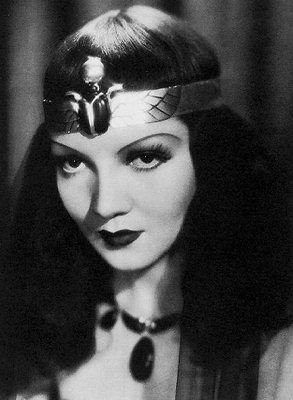
A messenger brings news of Anthony, sending Cleopatra into histrionics again: “Anthonio’s dead!” (II.v.26). After Cleopatra’s microscopic examination of any available nuances as potential clues, the messenger is able to continue. Cleopatra insultingly characterizes him as a merchant with his “pack” (II.v.54), selling his wares, and she will continue this comparison later in the scene (II.v.105f). Does it make sense that we should be encountering such denigrations from the pen of a Stratford grain-merchant and money-lender?
The messenger is finally able to report that Anthony married Octavia, Cleopatra interestingly says, “I am pale, Charmian” (II.v.59) — not “I feel faint!” or “Catch me!” — but as if she is part of her own observing audience. She pitches a fit. She strikes the messenger; “the Folio directs that Cleopatra ‘Strikes him down,’ ‘Strikes him,’ and ‘She hales him up and downe.'” This is not very dignified queenly behavior on Cleopatra’s part, of course, but “for these aspects of her character … Shakespeare had not far to look for a model. His own queen, brilliant and captivating, was yet capable of undignified spurts of rage, hysterical nerve storms, and public flirtation” (Morris 275). Ambassadors such as the Spanish Mendoza and other witnesses frequently refer to her tantrums (Morris 275-276). The historian Hume assesses Elizabeth’s conduct when she received the news of Leicester’s marriage to the Countess of Essex: “Her fury passed all bounds of decency and decorum; she raged and swore” (qtd. in Ogburn and Ogburn 262). Elizabeth seems to have inherited her father’s temper. Plutarch recorded no such emotional outbursts by the historical Cleopatra.
“Melt Egypt into Nile! and kindly creatures / Turn all to serpents!” (II.v.78-79). But she realizes she went too far and calls back the terrified messenger. Although distraught, she seems to have the resourcefulness to have her ladies grill the messenger for info about Anthony’s new wife: “the feature of Octavia, her years, / Her inclination; … / The color of her hair” (II.v.113-115).
As Cleopatra calms down a bit, she says of Anthony, “Though he be painted one way like a Gorgon, / The other way’s a Mars” (II.v.117-118). The reference is to Anthony as a kind of perspective painting (or “anamorphosis,” from the Greek meaning “formed again”), optical illusion art whereby the viewer sees one image from one stance and another image from a different vantage point. Shakespeare seems fascinated with the phenomenon and its implications in the arts: see in Richard II the reference to “perspectives, which rightly gaz’d upon / Show nothing but confusion; ey’d awry / Distinguish form” (II.ii.18-20); in Twelfth Night the reunion of the twins as “One face, one voice, one habit, and two persons; / A natural perspective, that is, and is not!” (V.i.216-217); and in Henry V (V.ii.320). (See also Sonnet #24.)
SCENE vi
Pompey meets with the triumvirate and a deal has already been proposed (II.vi.4, 34). Pompey is terse with Caesar, but after some camaraderie with Anthony he accepts the offer and invites them all to feast on his galley to celebrate the treaty. Enobarbus amuses Pompey with his brash wit, and then speaks with Menas, again, one is apt to think, going too far in predicting openly that the Octavia marriage won’t work and Anthony will return to Cleopatra, his “Egyptian dish” (II.vi.119).
SCENE vii
Two or three servants comment on the spectacle of drunken generals and officers taking place. Goddard insists there should be three servants to clash an admirable trio with the embarrassing triumvirate (188). One servant says that having a great name is a burden he would not want (II.vii.8f).
Meanwhile, Anthony is yammering with travelogue material, political buffer Lepidus is reduced to a soused fool by Anthony’s tautologies, and Caesar makes a nasty and puritanical drunk. We have a reference to “the Ptolomies’ pyramises” (II.vii.27). The singular can appear as “pyramis,” but Lepidus uses an improper “false plural,” probably with more drunken slurring. The Great Pyramid at Giza was constructed on a numerical base of 17, as was, according even to Stratfordian scholars such as Alastair Fowler, the structure of Shakespeares Sonnets, meaning that on top of a row of 17 (the distinct sequence of “procreation” sonnets) comes a row of 16, then 15, and so forth in ever-decreasing rows, totaling 153 units altogether at the top of the triangular structure, and Sonnet #153 thematically repeated in #154 (see Whittemore). The entrance to the Great Pyramid is on the 17th level; the structure is usually calculated as 153 meters high; there are 153 steps inside the King’s chamber; the Grand Gallery measures 153 feet (Alan Green 100). The number 17 is naturally of interest to Edward de Vere, 17th Earl of Oxford.
Menas calls Pompey aside, telling him that they could cut the cable and drift to sea, and then slit the throats of the triumvirs (II.vii.60ff). Pompey’s odd reaction is that Menas should have just done it instead of asking him — now he must condemn such an assassination plot (II.vii.63ff). “Here Shakespeare is plainly paying his compliments to the fatuousness of a humanity that can delegate all its power to three drunken men on a boat — let its destiny depend on the slender string of a galley’s cable and the still slenderer string of one man’s ‘honour'” (Goddard, II 189).
The sots sing a hymn to Bacchus. Stick-in-the-mud Caesar leaves the party saying, “our graver business / Frowns at this levity” (II.vii.108-109), and the party breaks up.
Anthony and Cleopatra, Act by Act
Anthony and Cleopatra Introduction
Anthony and Cleopatra Act II