ACT V
Gower reports that “Marina thus the brothel scapes, and chances / Into an honest house, our story says” (V.1-2). It says here she’s now teaching needlecraft and music, and has to give her earnings to the whorehouse owner, but at least it’s honest work. “Shakespeare’s royalties were enjoyed by the middle-men” (Beauclerk 306). Gower describes a Marina who represents the works:
She sings like one immortal, and she dances
As goddess-like to her admired lays. (V.0.3-4)
High winds have driven Pericles to Mytilene. “As in all the romances, there is a strong sense in Pericles that life is controlled by inscrutable, if ultimately beneficent, powers, symbolized by sea and storm” (Wells 335); “the storm in Pericles is as much a ritual event as it is a psychological one; it marks a passage” (Garber 767). So for the rest, sit down and shut the hell up. I mean, “please you sit and hark” (V.24).
SCENE i
Lysimachus boards Pericles’ ship, and Helicanus tells him that Pericles has refrained from eating and sleeping for three months. “Upon what ground is his distemperature?” “‘Twould be too tedious to repeat” (V.i.27-28). (At least, an acknowledgment about the last four acts.) Pericles will not speak to Lysimachus, who then tells Helicanus of a remarkable maiden in town who might be able to reason with Pericles. He sends a lord off to fetch her.
Marina comes, is praised. When she and Pericles meet, there is no recognition, of course. She sings a song to Pericles, but apparently he’s not into Aerosmith. (I’m just guessing; we don’t get the song in the text.)
Pericles grunts and pushes Marina away, prompting her yammering:
She speaks,
My lord, that may be hath endured a grief
Might equal yours, if both were justly weighed.
Though wayward Fortune did malign my state
My derivation was from ancestors
Who stood equivalent with mighty kings,
But time hath rooted out my parentage,
And to the world and awkward casualties
Bound me in servitude.
(V.i.77-85)
Marina’s story and her resemblance to her mother gradually bring Pericles to the realization that something is up.
I said, my lord, if you did know my parentage,
You would not do me violence.
(V.i.90-91)
Pericles employs birth imagery: “I am great with woe, and shall deliver weeping” (V.i.97). Oxford is complimenting Elizabeth (Ogburn and Ogburn 134) in saying,
My dearest wife was like this maid, and such a one
My daughter might have been. My queen’s square brows,
Her stature to an inch: as wand-like straight,
As silver-voiced, her eyes as jewel-like
And cased as richly, in pace, like Juno;
Who starves the ears she feeds and makes them hungry
The more she gives them speech. (V.i.98-104)
Start considering this portion of the play revised by the older de Vere and Marina symbolically representing the works. “If I should tell / my history, it would seem like lies / Disdained in the reporting” (V.i.108-110). “Falseness cannot come from thee, for thou lookest / Modest as Justice, and thou seemest a palace / For the crowned Truth to dwell in” (V.i.111-113). Pericles demands:
Report thy parentage. I think thou saidst
Thou hadst been tossed from wrong to injury,
And that thou thought’st thy griefs might equal mine,
If both were opened.
(V.i.120-123)
And Pericles commands like Hamlet: “Tell thy story” (V.i.125). When she tells him her name he thinks the gods are mocking him. More details send Pericles reeling with the realization that she was not killed in Tharsus. “It is a lesson in delayed response that Shakespeare teaches, in this prolonged revelation of kinship” (Bloom 611).
Dionyza (Diana gone wrong?) was the murderous one, but now we hear that “cruel Cleon, with his wicked wife, / Did seek to murder me” (V.i.171-172), of “savage Cleon” (V.i.215), and later of his particular murderous intentions (V.iii.8-9) — some serious inconsistency (Smidt 118).
Pericles’ joy is so great he fears he may keel over and die:
O Helicanus, strike me, honored sir,
Give me a gash, put me to present pain,
Lest this great sea of joys rushing upon me
O’erbear the shores of my mortality,
And drown me with their sweetness.
(V.i.180-184)
“It is as though, emerging from trauma, he requires a proof of his own fleshly mortality” (Bloom 612). Marina asks, “What is your title?” (V.i.193).
Incest casts Pericles upon the waves and divorces him from the name of king, but his own child, legitimately born, redeems him; hence his description of Marina as ‘Thou that begett’st him that did thee beget.’ Marina, born from the wrath of the goddess (like the flower born from the blood of Adonis), represents Oxford’s true child, the poetry that gives him new life. (Beauclerk 118)
Pericles is ready to clean himself up and assume responsibilities as ruler of Tyre, but he hears strange music and falls asleep. Everyone else exits, thinking it’s just his exhaustion. “Music surrounds and invests the restoration of parent to child, child to parent. The recognition is focused upon a riddle, and this riddle, too, will be an ‘incest’ riddle of sorts, marking a fruitful yet lawful relation between father and daughter” (Garber 772). “Thou that begett’st him that did thee beget” — “This famous riddling pronouncement, one of the play’s most vivid phrases, explicitly rewrites the Antiochan riddle with which Pericles began, purging it of sin and crime, rendering the connection between father and daughter allegorical and poetic rather than carnal” (Garber 773).
Pericles has a vision of “Celestial Dian, goddess argentine” (V.i.237), instructing him to come to her temple in Ephesus to find out whatever happened to Thaisa. Pericles wakes up and reprioritizes: first the temple, then vengeance on Cleon and Dionyza. Lysimachus asks about the possibility of marrying Marina, and Pericles has no gripe with it (although shouldn’t he be asking the whorehouse owner, technically?).
SCENE ii
“Now our sands are almost run, / More a little, and then dumb” (V.ii.1-2). Gower announces the engagement of Marina and Lysimachus. He reports, also superfluously, that Pericles is going to the temple of Diana at Ephesus. “Essentially, there are only two deities in Pericles, Neptune and Diana, and Diana wins. What are we to make of that victory?” (Bloom 605).
SCENE iii
Pericles arrives at the temple of Diana, bringing pompous announcements of self and blabbing his life story. Thaisa is the priestess there and hears it all, eventually fainting. Cerimon says that if all Pericles says is true, then the priestess is Pericles’ wife, overcome with joy. Voice recognition and ring recognition confirm the identifications, and Pericles welcomes his long-lost wife: “O, come, be buried / A second time within these arms” (V.iii.43-44). “Astonishingly, the second one [second recognition scene] — the reunion of husband and wife, Pericles and Thaisa — does not come off as an anticlimax. The scene is, designedly, much briefer, the recognition more abrupt” (Garber 774).
Marina meets her mother at last, kneeling before her. Helicanus is introduced to Thaisa — she’d heard such nice things about him. Cerimon promises to explain his role in reviving the dead queen, and Pericles thanks the goddess Diana, promising to shave.
“My father’s dead” (V.iii.79), Thaisa adds. (Timing is everything.) So Pericles and she will reign in that kingdom, Marina and Lysimachus in Tyre. Off we go to hear what Cerimon has to recount.
“It is comforting, no doubt, to see wickedness punished and virtue rewarded, but we have seen the wicked flourish and the good people suffer for so long that we may well wonder what the gods have been up to. And, before the end, their evident moodiness has given us no great cause for confidence in their concern for justice” (Smidt 115).
EPILOGUE
Gower can’t leave it alone. He provides a bit of an epilogue, first mentioning yet again the incest of Antiochus and his daughter (just as “o moral Gower,” as Chaucer called him, seems to have fancied himself a dour moralist but dwelt on the perverse whenever possible within his supposedly sanctimonious poetic framework). He insists that good triumphs over evil, and that Pericles and his family were rewarded for their virtuous perseverance. Helicanus was loyal and Cerimon was learned and charitable. “Gower’s summing up in the Epilogue could then be put down to the kind of obligatory edification to be expected of a presenter” (Smidt 116).
Gower reports that the citizens were so horrified with Cleon and Dionyza that they burned them in their own palace. “So on your patience evermore attending, / New joy wait on you. Here our play has ending” (Epilogue 17-18). “E. Vere had had his say” (Ogburn and Ogburn 135).
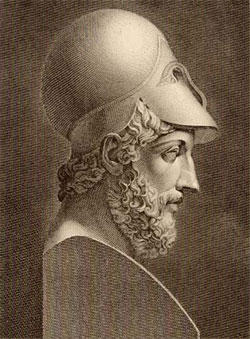
FINAL PERSPECTIVE
“The play remains an exciting series of adventures that violate the unities of time and place in most undramatic fashion. It is held together by narrative suspense and a certain interest in the three main characters, not by any dominating theme. So, while there are passages that approach or reach perfection, the piece as a whole lacks the universality that sends us back again and again to such a play as The Tempest … in search of more and more hidden truth” (Goddard II, 242).
“Libraries have been written on the personality of Hamlet, but Pericles has none whatsoever” (Bloom 604). He is “a protagonist who is merely a cipher, a name upon the page” (Bloom 606). Farina suggests this explanation: that the play as we know it began as
a scenario in which Shakespeare’s Pericles may have been originally drafted into a performing version by William Stanley, attracted to Gower’s characters by similarities to members of his own family. At some point, de Vere was then invited to revise, and did so up to a point, before disregarding the work and turning his attention to the superior merits of The Winter’s Tale. (Farina 101)
There are shadowy Oxfordian connections:
He had been married to a lady of great position, he had been on a voyage at sea, an infant daughter had been born while he was travelling, and because of the birth of that daughter, he had lost his wife, though she did not die. (Clark 61)
Beauclerk says that the play speaks “eloquently to the isolation he felt, and his apparent helplessness in the face of fortune’s buffets” (117).
The Earl of Oxford, at the age of twenty-seven, was anxious to see his baby daughter, according to the Duchess of Suffolk’s letter, but was afraid to take the first step towards reconciliation with his wife so that he might see the child, apparently for fear of the world’s laughter. (Clark 77)
Calling Marina a “fairy” seems maudlin, but the term might apply better to a two-and-a-half-year-old.
But more than the generic biographical connections, “the parent-child, particularly the father-daughter, relationship was assuming increased importance in Shakespeare’s mind toward the end of his life” (Goddard, II 243). We begin to consider the allegorical implications of these daughters (Marina, Perdita, Miranda) as representing the works of the poet/playwright. What does it mean then that Marina is placed in a whorehouse? That the key question concerns her “parentage”?
The elder Ogburns claim that the play was left out of the First Folio not because it was insufficiently Shakespearean, but rather because it was known as Shakespeare’s work (Ogburn and Ogburn 131). Oxford, they think, suspected Burghley of instigating the pirate attack on him during his return (131), though the character Simonides provides an internal alibi against the easy notion of Oxford attacking him in Pericles (134). They very gingerly suggest that there’s a more direct revelation in the first act of the play as to the gruesome nature of the relationship between Burghley and his daughter Anne (963), perhaps connected to Hamlet’s very oblique remarks about Polonius/Burghley and Ophelia/Anne Cecil….
Pericles, Act by Act
Pericles Act V