ACT I
SCENE i
From the start, the concern with comparing and quantifying emerges, innocuously at first as court gossip: “I thought the King had more affected the Duke of Albany than Cornwall” (I.i.1-2). The Earls of Gloucester and Kent are discussing King Lear’s plan to divide his kingdom among his daughters, the older two of whom, Goneril and Regan, are married to the Dukes of Albany and Cornwall respectively. “In Shakespeare’s time, the title ‘Duke of Albany’ was held by James VI of Scotland” — later King James I (though there is a better prototype…); “there was no contemporary Duke of Cornwall to take umbrage” (Asimov 19-20). Note that the Earls are aware of Lear’s specific planned divisions of his kingdom (I.i.4-6). (What does that render the love test?)
Gloucester has one legitimate son, Edgar, and one bastard, Edmund, and he may esteem them equally (I.i.19f) but he jokes with Kent about the bawdy origins of Edmund’s “breeding” (I.i.8) while the young man is present (I.i.12), puns on the word “conceive” (I.i.11-12), even remarking that “there was good sport at his making, and the whoreson must be acknowledged” (I.i.23-24)! Kent is more polite and addresses Edmund directly: “I must love you, and sue to now you better” (I.i.30). Edmund’s reply — “Sir, I shall study deserving” (I.i.31) — means he’ll exert efforts to be worthy of such a friendship, but the phrase also sounds calculating.
We hear about bastardy in 27 of the 37 plays (Farina 205). Oxford was known to be touchy about this issue of illegitimacy, a kind of “bastard anxiety” (Anderson 24-25). Like Gloucester, Oxford had two sons: Henry the 18th Earl and Edward the illegitimate son with Anne Vavasour. And de Vere himself was sensitive to the accusation. The Howard and Arundel libels “raked up the old story of his half-sister’s effort to have him declared illegitimate” to try to rob him of his inheritance,
and had recalled his youthful rage and humiliation upon the Queen’s taunting him with it, when he had burst into tears and dashed from the room. They had quoted him as having declared that “The Queen sayd he was a bastard for whiche cause he wold never love hir and wold leve hir in the lurche one day.” (Ogburn and Ogburn 416; cf. Anderson 25)
In any case, the Edgar/Edmund, true-born or bastard phenomenon probably reflects Oxford’s own identity crisis (Beauclerk 299).
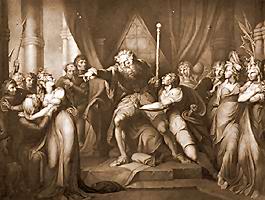
Lear enters with pomp, and the Dukes, and his daughters: Goneril, Regan, and Cordelia. [Cor = heart; Delia = Greek name for Cynthia, the moon-goddess (Ogburn and Ogburn 1163-1164).] “Lear is at once father, king, and a kind of mortal god: he is the image of male authority, perhaps the ultimate representation of the Dead White European Male” (Bloom 478). Gloucester must attend the King of France and the Duke of Burgundy, both of whom seek to court Cordelia.
Lear announces, probably with a chuckle, that he “shall express our darker purpose” (I.i.35), meaning the secret as to why we are gathered here. (But Gloucester and Kent already know the details!) Lear has divided his kingdom in three parts and, weary of the duties, hopes
To shake all cares and business from our age,
Conferring them on younger strengths, while we
Unburthen’d crawl toward death. (I.i.39)
The last line probably with another intended ironic bit of gallowshumor to solicit a “No, no!” from attendants. But it is “as if he had regressed to the posture and position of a child” (Garber 653). And a leader’s role, it used to be well understood, is to unify, not divide (God help us all now). Yet Lear will distribute the kingdom in accordance with his daughters’ public declarations of devotion for him. We know, however, that the map has already been crafted, so the “love test” (if it can even be called that) is a “mere whim” (Smidt 130) and narcissistic show, such as Elizabeth fostered in her court with the courtiers vying for her favor.
Goneril lays it on thick: “Sir, I love you more than words can wield the matter, / Dearer than eyesight, space, and liberty” (I.i.55-56). These three things will be taken away during the course of the play. Regan lays it on thicker: “I profess / Myself an enemy to all other joys” (I.i.72-73). Her use of economic terms such as “prize,” “worth,” and “deed” is revealing (Garber 654).
Cordelia, in an aside, declares, “I am sure my love’s / More ponderous than my tongue” (I.i.77-78). When Lear turns to her, it is clear he expects something rapturous: “what can you say to draw / A third more opulent than your sisters’? Speak” (I.i.85-86). But she is laconic: “Nothing, my lord.” Perhaps “Lear’s rhetorical power itself largely renders Cordelia mute and recalcitrant” (Bloom 494). “Nothing?” “Nothing.” “Nothing will come of nothing, speak again” (I.i.87-90). The word “nothing” thus becomes thematic, appearing 30 times in the play (Beauclerk 300). Cordelia merely claims to love Lear as is her filial duty. “I cannot heave / My heart into my mouth. I love your majesty / According to my bond” (I.i.91-93). And “Why have my sisters husbands, if they say / They love you all?” (I.i.99-100). Burn!
Lear is enraged; he rants and disinherits her. “Cornwall and Albany. / With my two daughters’ dow’rs digest the third” (I.i.127-128). The Earl of Kent comes forth: “Royal Lear, / Whom I have ever honor’d as my king” (I.i.139-140). He laments the consequences “When power to flattery bows” (I.i.149). (God help us all.) Early Oxfordians connected Kent with Sir Francis Drake, who also eventually suffered royal ingratitude (Ogburn and Ogburn 1125f). Yet Oxford himself is the better connection, loyal to Elizabeth (Ogburn and Ogburn 1127) and also banished for a time (Ogburn and Ogburn 1124, 1156) for what he would have considered truth-telling (Beauclerk 307). Kent’s words might have been Oxford’s to the abusive Elizabeth:
My life I never held but as a pawn
To wage against thine enemies, ne’er fear to lose it,
Thy safety being the motive. (I.i.156-158)
Oxford took as his job description the insistences of Castiglione in The Courtier:
I think then that the aim of the perfect Courtier … is so to win for himself … the favor and mind of the prince whom he serves, that he may be able to say, and always shall say, the truth about everything which is fitting for the prince to know, without fear, or risk of giving offense thereby; and that when he sees his prince’s mind inclined to do something wrong, he may be quick to oppose, and gently to make use of the favor acquired by his good accomplishments, so as to banish every bad intent and lead his prince into the path of virtue…. [C]ertain it is that man’s mind tends to the best end, who purposes to see to it that his prince shall be deceived by no one, shall hearken not to flatterers or to slanderers and liars, and shall distinguish good and evil, and love the one and hate the other. (Castiglione, The Book of the Courtier 2299).
(God help us all.)
Unfortunately, this approach does not work with tyrants. “Out of my sight!” (I.i.158), responds Lear, introducing another theme. Kent advises Lear that it’s a bad idea to abdicate and assures Lear that Cordelia does not love him less. But Kent just gets himself banished as Lear borrows some characteristic phrases from Queen Elizabeth: “On thine allegiance” (I.i.168) and “our vows” (I.i.169). Kent leaves nobly, hoping that the words of the two elder sisters translate into actions: “See better, Lear, and let me still remain / The true blank of thine eye” (I.i.159-160). “From this moment on, the story of King Lear is the story of the slow acquirement of that better vision” (Goddard, II 144).
Gloucester returns with the King of France and the Duke of Burgundy. Cordelia now faces penury — “now her price is fallen” (I.i.198) — and she explains that she refused to flatter Lear. The lack of a dowry makes Burgundy reconsider his interests, but Lear is firm and Cordelia has no interest in someone looking only for a dowry anyway. The King of France, however, is impressed. Cordelia is realistic about the insincerity of her sisters; but, noting “I know you what you are” (I.i.271), wishes well to all, receiving snippy retorts from Goneril and Regan. When alone, the two sisters comment on events: “‘Tis the infirmity of his age, yet he hath ever but slenderly known himself” (I.i.294-295). They agree to work together towards insuring their good fortune.
Although Goneril and Regan could partially represent the dark side of Elizabeth (Beauclerk 294), it is compelling to consider further Oxford and his three daughters. A dismissal of this relevance relies on a locking in of the composition to about 1590, as in 1591 Oxford alienated Hedingham, the family seat, to his three daughters and Burghley (Ogburn and Ogburn 1131; Anderson xxvii, 248). The daughters were too young at that time to serve as prototypes for Lear’s daughters. But many of us think a final draft of the play came in Oxford’s “closing years” (Anderson 380). In this late revision of the play, the playwright “describes the conflict de Vere must have felt between filial devotion and self preservation” (Anderson 248). We don’t know what the relationships between Oxford and his daughters may have been, though I can’t imagine there was much closeness with the oldest, Elizabeth Vere, after Oxford denied paternity for the first several years of her life. Many want to see Oxford’s youngest daughter, Susan Vere, as Cordelia (e.g., Anderson 354, 371; Farina 205), who proved interested in theater after Oxford’s disappearance in 1604 (Beauclerk 344). Instead of a gift for participation in a masque, Susan received an intriguing epigram from John Davies: “Nothing’s your lot. That’s more than can be told. / For Nothing is more precious than gold” (qtd. in Anderson 354).
SCENE ii
Edmund seems somehow not to be “in the same play as Lear and Cordelia (Bloom 501). His and Lear’s paths never really cross: “they are apocalyptic antitheses” (Bloom 479). Edmund reveals in a raging but rationalizing soliloquy that he is a real bastard and has set his sites on his half-brother Edgar’s inheritance. Edmund has a fake letter towards this end.
When Gloucester arrives, Edmund makes a show of hastily concealing the letter, which makes Gloucester demand to see it: “What paper were you reading?” “Nothing, my lord.” “No? … The quality of nothing hath not such need to hide itself” (I.ii.31-35). The letter tactfully paints a rosy economic picture of Daddy Gloucester being dead, signed, Edgar. Edmund feigns disbelief that Edgar could be so treacherous, yet Edgar has often declared “it to be fit that, sons at perfect age and fathers declin’d, the father should be as ward to the son, and the son manage his revenue” (I.ii.72-74). Gloucester rants and Edmund, Iago-like, promises to arrange for Gloucester to witness some evidence of Edgar’s treachery. Gloucester laments the widespread moral degeneration he’s been witnessing, along with the portentiousness of “These late eclipses in the sun and moon” (I.ii.103). For some critics, the reference dates the play to 1605, but eclipses were notable in 1601 (Kermode 1298) and other years, of course, such as 1590, and a more famous double eclipse near London occurred in 1598 [see Richard Whalen’s “A Dozen Shakespeare Plays Written After Oxford Died? Not Proven!” The Oxfordian 10 (2007): 77]. When “a solar eclipse occurs, there is usually an equally striking lunar eclipse 15 days earlier or 15 days later” (Ogburn and Ogburn 441).
Alone, Edmund snickers at the notion of astrological influence in determining character. Oxford’s dastardly enemy, “Lord Henry Howard, who was long suspected of intrigues with Mary, Queen of Scots, seems to have been the model for the character of Edmund. Edmund’s comments on astrological matters suggest Howard’s attack on Richard Harvey’s work in astrology” (Clark 872; cf. Ogburn and Ogburn 1129). “As often in Shakespeare, belief in self-determination is allied to a denial of supernatural influence; rationality in an evil character is opposed to credulity in a more sympathetic one” (Wells 268). “Like Iago in Othello, the evil characters in King Lear are notable for rationality” (Wells 267). Edmund in his opportunism also represents the “new men” in the Early Modern period: grasping non-aristocratic politicians (Beauclerk 293).
Edmund refers to his father’s having “compounded” with his mother (I.ii.128). Then Edgar arrives and Edmund convinces him, with evenly-paced Iago-like skill in deception, that Gloucester is homicidally angry at Edgar. Edgar assumes, “Some villain hath done me wrong” (I.ii.163). Edmund tells Edgar that he should arm himself. Afterwards, Edmund snickers some more about his plotting:
A credulous father and a brother noble,
Whose nature is so far from doing harms
That he suspects none; on whose foolish honesty
My practices ride easy. I see the business.
Let me, if not by birth, have lands by wit:
All with me ‘s meet that I can fashion fit.
(I.ii.177-182)
SCENE iii
Goneril’s steward Oswald has been chiding Lear’s Fool, so Lear struck him. Goneril takes the opportunity to be put out by her father and his large number of retainers. Old men are like babies, and need disciplining (I.iii.20-21), and she hopes her father will move on to Regan’s household and receive the same cold treatment. Oswald and the servants are to pay less attention to Lear and his followers from now on.
SCENE iv
Kent has disguised himself as an attendant (named Caius as we learn only near the end of the play): “where tyranny prevails, truth must go disguised” (Beauclerk 288). He adopts a fake voice and his reference to having “raz’d” his likeness (I.iv.4) often is used in productions to refer to his having shaved off his beard. Kent hopes to find employment with Lear, which he achieves quick-wittedly at a dinnertime interview:
I can keep honest counsel, ride, run, mar a curious tale in telling it, and deliver a plain message bluntly. That which ordinary men are fit for, I am qualified in, and the best of me is diligence. (I.iv.32-35)
He also professes “to eat no fish” (I.iv.17), which probably signifies that he is a staunch Protestant (Clark 877), as Sir Francis Drake bragged. He claims to be 48 years old (I.iv.38-39), which Drake would have been at the end of the 1580s (but which Oxford would have been at the end of the 1590s).
Lear summons his Fool and asks Oswald about Goneril. Oswald all but snubs Lear and departs, the
“clotpole” (I.iv.46), further ignoring a knight’s inquiries. Lear acknowledges the cooling off of courtesies and hears that the Fool has been melancholy ever since Cordelia left for France. Lear demands to see Goneril and the Fool. Oswald returns, is snotty, and Lear strikes him. When he starts to mouth off again, Kent trips him and shoves him out, calling him a “base football player” (I.iv.84-85). According to Sir Thomas Eliot in 1531, “football was [“was”??] a lower-class game of ‘beastly fury and extreme violence,’ to be utterly abjected of all noblemen” (qtd. in Foakes 196). Lear is pleased with this new servant.
The Fool brings some relief in the form of wit “though it is debatable how funny he actually is” (Smidt 133). It’s more a matter of wisdom about Lear’s bad decisions, with enigmatic assertions such as, “Truth’s a dog must to the kennel, he must be whipt out, when the Lady Brach may stand by th’ fire and stink” (I.iv.109-111). The Fool sings songs and quibbles on the concept of “nothing.” Lear reasserts, “nothing can be made out of nothing” (I.iv.130; cp. I.i.90), and many productions of the play have Lear realize the echo with a twinge. “This is not altogether fool, my lord,” notes Kent (I.iv.144). The Fool calls Lear “an O without a figure” (I.iv.183). The Fool is termed “Lear’s shadow” (I.iv.222) (Ogburn and Ogburn 1124).
Goneril arrives and is bitchy; she wants Lear to downsize his 100-knight retinue: “knights and squires, / Men so disordered, so debauched and bold, / That this our court, infected with their manners, / Shows like a riotous inn” (I.iv.232-235). These men might be considered the “lewd friends” that Burghley complained about Oxford hanging out with (Ogburn and Ogburn 1130). Lear’s reaction at the loss of his retainers parallels “the bitterness of Lord Oxford when his company of actors was dissolved” (Clark 871). Lear is dismayed at this treatment: “Are you our daughter?” (I.iv.209) — a question Oxford had asked about his own oldest “daughter” (?), and at least for a time he himself answered in the negative in the later 1570s.
He decides he will visit his other daughter, Regan. Despite Albany’s ineffectual courtesy, Lear calls upon nature to make Goneril sterile: “Dry up in her the organs of increase” (I.iv.271). “Thus Lear’s intemperate words to Cordelia (‘Nothing will come of nothing’) are now transposed into his physical curse on Goneril — that nothing (no child) should come of her ‘no thing'” (Garber 665). If that curse doesn’t work, then may the gods give her a brat. “How sharper than a serpent’s tooth it is / To have a thankless child” (I.iv.280-281). Lear finds out that Goneril has sent off fifty of his knights and rages that Goneril has the power to wrench tears from his eyes: “Old fond eyes, / Beweep this cause again, I’ll pluck ye out” (I.iv.293-294). Lear predicts that Regan will flay Goneril’s face with her fingernails (I.iv.299-300). Albany is somewhat sympathetic, but Goneril shuts him up and has Oswald convey a letter advising Regan to keep up the shoddy treatment. She then chides Albany her husband for tending towards “milky” leniency (I.iv.337), echoing Lady Macbeth.
SCENE v
Lear sends Kent with a letter to Regan in the city of Gloucester. The Fool engages Lear’s wit, explaining enigmatically that one’s nose is in the middle of one’s face “to keep one’s eyes of either side ‘s nose, that what a man cannot smell out, he may spy into” (I.v.22-23). Further, the reason a snail has a house is “to put ‘s head in, not to give it away to his daughters” (I.v.29-30). It sounds as if Oxford planted a subtle, painful, partial pun here: again, giving away his family home, Hed–in-gham (Ogburn and Ogburn 1131, Beauclerk 330).
Out of the blue, Lear says, “I did her wrong” (I.v.24). The Fool laments, “Thou shouldst not have been old till thou hadst been wise” (I.v.41-42; cf. I.iv.231). [The line also echoes one in Lucrece: “Priam, why art thou old, and yet not wise?” (1550).] Lear prays not to go mad (I.v.43-45).
King Lear, Act by Act
King Lear Act I