ACT I
SCENE i
The first word is “Nay,” establishing themes of negation, or denouncement, or defiance. A soldier, Philo, is denigrating his general, Mark Anthony, as a once-great warrior, “but this dotage … / O’erflows the measure” (I.i.1-2), and from the start we have also the theme of excess. Addicted to life with Cleopatra with her “tawny front” (I.i.6) recently, Anthony seems, to the soldiers, reduced to a gigolo: “his captain’s heart … become the bellows and the fan / To cool a gipsy’s lust” (I.i.6-10). As one of the triumvirate with Octavius and Lepidus, he is lamented as “The triple pillar of the world transform’d / Into a strumpet’s fool” (I.i.12-13). This opening perspective is not privileged, however; disapproval is cast by many knaves in this play. And “gipsy” is a shortened from “Egyptian,” used as a derogatory term here.
Philo’s announcement, “Behold and see” (I.i.13), haughtily cues what seems a show. He’d probably use the word “spectacle,” but he’s treating the couple exactly in the way he disapproves of! If Shakespeare’s Cleopatra is the first “diva,” then other facets of celebrity culture are already appearing.
Anthony and Cleopatra enter with attendants and with eunuchs fanning the queen. She’s wheedling, how much do you love me? (This is the theme of measurement and excess already emerging again.) And Anthony is bombastic in his response. The whole world is the setting and these grandiose protagonists see themselves in hyperbolic terms: not just monarchical but godlike. “There’s beggary in the love that can be reckon’d” (I.i.15) — anything measurable is so much piffle. Is there a difference for Cleopatra and Anthony between being themselves and acting themselves? Or does love do this to everyone? In their favor, they both seem perfectly aware of the histrionic games they’re playing with each other.
A message from Rome is announced. Anthony is impatient and dismissive: “Grates me, the sum” (I.i.18). In other words: this irritates me; give me the bottom line — but Anthony renders it in telegraphic brevity to convey the annoyance and impatience. Cleopatra petulantly and derisively suggests that it might be Anthony’s wife Fulvia pitching a fit, or Octavius Caesar ordering Anthony around with daily errands of the caliber of, oh, seizing kingdoms and such. But Anthony pontificates:
Let Rome in Tiber melt, and the wide arch
Of the rang’d empire fall. Here is my space,
Kingdoms are clay; our dungy earth alike
Feeds beast as man; the nobleness of life
Is to do thus [embracing] — when such a mutual pair
And such a twain can do ‘t, in which I bind,
On pain of punishment, the world to weet
We stand up peerless. (I.i.33-40)
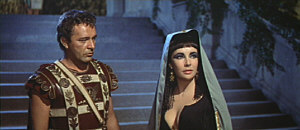
Whether or not Oxford and Queen Elizabeth were lovers, and, if so, whatever he may have thought would come of it, nevertheless he must have ruminated occasionally in these triumphal terms at periods in the 1570s during which he was an unrivalled favorite of hers, as attested to by Philo-like courtiers.
The description of this “wrangling queen, / Whom every thing becomes (I.i.48-49), whose “every passion” (I.i.50), or fit, is attractive, resembles the kind of flattery that courtiers lavished on Queen Elizabeth. She still commands Anthony to hear the ambassadors, but Anthony is geared up for their date of people-watching: “To-night we’ll wander through the streets and note / The qualities of people” (I.i.53-54). Not the evening debauchery Philo led us to expect. Queen Elizabeth at least once disguised herself as a serving-maid to attend a shooting-match; might she and Oxford for fun have wandered in disguise at other times? Philo and Demetrius shake their heads tsk tsk, though their discussion ends on a note of odd optimism.
The thematic Shakespearean concern for the “self” is clearly at stake in this play already. Cleopatra mentions, “I’ll seem the fool I am not. Anthony / Will be himself” (I.i.42-43); and Philo makes a distinction between Anthony as defined in and by the public realm and, conversely, “sometimes when he is not Anthony” (I.i.57), that is, when he falls short of his reputation as a heroic Roman general.
SCENE ii
Cleopatra’s attendant Charmian calls to another: “Lord Alexas, sweet Alexas, most anything Alexas, / almost most absolute Alexas (I.ii.1-2). The tone is one of jaded world-weariness expressed in over-the-top ceremonious praise — the haughty tone not of an Egyptian slave but of an aristocratic Elizabethan court lady. Charmian wants Alexas to call forth a soothsayer he recently praised.
The soothsayer enters. “Your will?” (I.ii.7), he asks. “In Nature’s infinite book of secrecy / A little I can read” (I.ii.8-9). Oxford was a supporter and perhaps in some respects a student of the spiritualist and polymath Dr. John Dee, Elizabeth’s trusted astrologer. After revealing their treasonous plans to the Queen, Oxford was accused by the desperate Howard and Arundel of sinister involvement in the supernatural and of possessing a forbidden book of necromancy. This so-called “Book of Prophecies” or “book of babies” presumably involved astrological nativities to be used for political ends. Arundel claimed that Oxford compiled the treasonous book under demonic influence, that the work prophesied Queen Elizabeth’s death, and that it identified a royal son as her male successor.
“Show him your hand” (I.ii.9). This scene with the Soothsayer depicts private court pastimes. In a parallel to the royal court in Shakespeare’s time, Queen Elizabeth’s chief gentlewoman of the Privy Chamber, Blanche Parry “made a special study of palmistry” and occasionally told the fortunes of maids of honor (Wilson 7-8; qtd. in Rinehart 85). Furthermore, “the women of the Egyptian court have functions similar in most respects to those of Elizabeth’s attendants” (Brown 136); Charmian and Iras are not presented as Egyptian slaves but as aristocratic gentlewomen (136).
Charmian wants a good fortune, but the soothsayer reads ’em like he sees ’em.
The prediction, “you shall paint when you are old” (I.ii.15), or, apply cosmetics, brings to mind that Queen Elizabeth famously increased her use of “paint” in later years. Charmian giddily speculates about being married to “three kings” (I.ii.22) “having a child at fifty, to whom Herod of Jewry may do homage” (I.ii.23-24) and marrying Octavius Caesar; but the soothsayer says only, “You shall outlive the lady whom you serve” (I.ii.26), but not how long. And it seems as if bad times are ahead. The implication is that Iras is of easy virtue, but the soothsayer prognosticates an identical fate for her as for Charmian.
When Charmian is fifty years old, the Christian era will indeed be approaching. Giving birth at the advanced age may allude to the Virgin Mary’s cousin Elizabeth, mother of John the Baptist, whose feast day is June 24th, Midsummer Day and the day of Oxford’s alleged death in 1604. 6/24 is also the number of letters in Edward (6) de (2) Vere (4) – and backwards, Earl (4) of (2) Oxford (6) — and of the lines in the inverted triangles (pyramids?) on the odd dedication page to the Sonnets. And so on.
Cleopatra comes looking for Anthony, worrying that “A Roman thought” (I.ii.70) has struck Anthony (meaning a thought about Rome, or in the character of Rome: serious, dutiful). Anthony hears from the messenger that his brother and his wife, Fulvia, joined forces against Caesar but were defeated. Anthony asks for the Roman perspective on Cleopatra and himself: “Name Cleopatra as she is called in Rome” (I.ii.94). In her time, Queen Elizabeth was called in Rome — that is, by the Pope — a bastard and a whore.
Anthony seems desirous to break away from his life of luxury: “These strong Egyptian fetters I must break, / Or lose myself in dotage” (I.ii.104-105). This self-disgust resembles that of the poet concerning his sexual addiction to the dark lady in the Sonnets.
Throughout the play, as in this scene, there are lots of “to-ings and fro-ings,” primarily of messengers, “creating a sense of continual movement and urgency” (Wells 303, 304). Another messenger now brings Anthony news that Fulvia is dead. “There’s a great spirit gone!” (I.ii.110), laments Anthony, realizing he didn’t appreciate her until now when it’s too late. Oxford seems not to have been home when his wife Anne died. If the plays are an indication, he seems to have had difficulty forgiving himself for cherishing her too late. In the immediate context here, though, Shakespeare gives us an instance of Anthony’s quickly shifting perspectives.
Enobarbus, Anthony’s cynical friend and “the detached observer who [seems] least likely to be seduced by Cleopatra’s wiles” (Wells 302), enters and, regarding the rumored possibility of their returning to Rome, states that all the women will die if they leave. He’s probably punning with the Elizabethan sexual meanings of “die” and “nothing,” but this before he hears the news of Anthony’s wife’s death. Enobarbus notes that Anthony lost a wife he didn’t want, and tries to continue his bawdy punning, but Anthony says, “No more light answers” (I.ii.158). He mentions that there are several reasons they must return to Rome, including the threat posed by Sextus Pompeius, son of Pompey the Great and now lauded by “Our slippery people” (I.ii.167) — an aristocratic attitude about the fickle populace, encountered throughout the works.
The phrase “blood and life” (I.ii.172), meaning courage and energy, Oxford uses in a 1572 letter to his father-in-law Burghley: “you as one with whom I would spend my blood and life, so much you have made me yours.”
SCENE iii
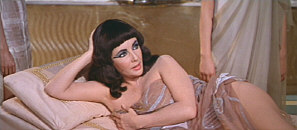
Cleopatra, whose focused devotion requires no pronoun antecedents, tells Charmian,
See where he is, who’s with him, what he does.
I did not send you. If you find him sad,
Say I am dancing; if in mirth, report
That I am sudden sick. (I.iii.2-5)
Charmian expresses her opposing belief in being honest and agreeable with a lover, the silly git. Anthony enters and can’t get a word in edgewise due to Cleopatra’s dying-duck fits. When she finally hears of Fulvia’s death, she still manages to play martyr and engage in the “childish histrionics” (Carey 453) and “beguiling craftiness” (460) of a “scheming coquette” (458). She laments Anthony’s anticipated reaction at her own death since he sheds no tears for Fulvia now (as if his crying now wouldn’t have sent her on another worse rant) — in other words, how Fulvia’s death affects her is the focus. As a few of my students have pointed out, Cleopatra makes Anthony’s “presence in her life more certain by drawing his attentions to her instead of his own feelings.”
Anthony tries to be straightforward: “The strong necessity of time commands / Our services awhile, but my full heart / Remains in use with you” (I.iii.42-44), or, for you to command. This is a legal term that distinguishes an item in trust from one in absolute possession, but a term so unassuming that one is apt to miss that Shakespeare here again unintentionally reveals his sophisticated knowledge of the law. Oxford studied at the Inns of Court.
“Cut my lace” (I.iii.71), Cleopatra calls, with fashion anachronism; but see also Richard III (IV.i.33) and The Winter’s Tale (III.ii.173). Could such an emergency call, this pretense of being on the verge of fainting, have been one of Queen Elizabeth’s histrionic tactics? Cleopatra snarks at Anthony, “Good now, play one scene / Of excellent dissembling, and let it look / Like perfect honor” (I.iii.78-80). Cleopatra is focused on issues of performance and theatricality in her sarcastic mockery of Anthony. Nevertheless, Anthony will leave.
SCENE iv
Anthony’s “co-triumvirs” in Rome — Octavius Caesar and Lepidus — discuss the state of the State, with Caesar sniping about Anthony and insulting his manhood and his weakness for Cleopatra. News of the new Pompey at sea and his popularity prompts Caesar to insult the populace, much like Anthony had. In an apostrophe to the absent Anthony, Caesar lists his faults, but some of what Octavius Caesar considers dishonorable behavior actually seems admirable. Caesar recounts the debased extremes Anthony resorted to during a famine following military defeat, but it sounds impressive (I.iv.56ff). “As a result, his attempt to turn these incidents into an indictment against Antony tells us, in reality, more about young Caesar’s insecurities than it does about Antony” (Carey 460) — in other words, Caesar and Cleopatra overlap in behavior somewhat.
SCENE v
Cleopatra is bored and thinking of Anthony. She wants to sleep the time away with the help of a narcotic, mandragora, but banters a while with Mardian, a eunuch. She notes fondly that Anthony calls her “my serpent of old Nile” (I.v.26). The Rainbow Portrait of Queen Elizabeth shows serpents represented on her sleeves, indicative of wisdom, although Anne Vavasour, Oxford’s mistress, looks serpentine herself in her surviving portrait. Cleopatra declares herself “wrinkled deep in time” (I.v.30), but she was only 28 years old here. Queen Elizabeth was seventeen years older than Oxford, though….
Cleopatra is also compared to food: when Julius Caesar was alive, she was “A morsel for a monarch” (I.v.32). Alexas enters, bringing an “orient pearl” (I.v.43) that Anthony has kissed and sent Cleopatra. [Note: the most enormous pearl of the sixteenth century, known as La Peregrina, was discovered in 1513, given by Philip II of Spain to Mary Tudor in 1554, and purchased in 1969 by Richard Burton for Elizabeth Taylor (Antony and Cleopatra in the 1963 film extravaganza Cleopatra).]
When Cleopatra hears that Anthony was neither sad nor merry, she raves about his marvelously medium mood.
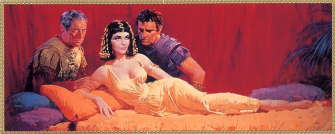
Cleopatra makes Charmian insist that Anthony, not Julius Caesar, is her one true love. She threatens the woman with “bloody teeth” (I.v.72). Queen Elizabeth was guilty of royal violence against her ladies, once handling a maid-of-honor so roughly that she struck her and broke her little finger, another time stabbing the hand of a serving lady with her knife (Beauclerk 54). See Cleopatra’s violent behavior below (2.5), even though Plutarch recorded no such historical hysterical outbursts.
Cleopatra dismisses the earlier affair with Julius Caesar as having come during “My salad days, / When I was green in judgment, cold in blood” (I.v.75-76). “It is tempting, though unhistorical, to think of her as the original ‘Caesar salad.’ Alas, that Caesar was a Mexican restauranteur of the 1920s” (Garber 744). The phrase “salad days” has come to signify a time of economic hardship and scrimping, when hot meals may have been a rarity — graduate school, basically — but Cleopatra means nothing so nostalgic. She is using the phrase not as we do to mean times of romantic poverty or colorful youth, but rather as an image of inexperience and passionlessness.
Her dismissiveness about Caesar now that she considers herself more mature may dramatize some wishful thinking on Oxford’s part regarding the older Robert Dudley, Earl of Leicester, who was Queen Elizabeth’s clear favorite prior to the ascendancy of Oxford himself.
Back to the topic of Anthony: “Get me ink and paper. / He shall have every day a several greeting, / Or I’ll unpeople Egypt” (I.v.78-80). She seems to mean that she will empty out the population by sending them all out as messengers to Anthony, although with the disturbing hint of genocide too, ending the act with another indication of Cleopatra’s extremism.
Anthony and Cleopatra, Act by Act
Anthony and Cleopatra Introduction
Anthony and Cleopatra Act I