ACT IV
SCENE i
Octavius is outraged at Anthony’s letter, starting with Anthony calling him “boy” (IV.i.1) — a term consistent with Oxford’s assessment of Philip Sidney not just in the famous tennis match quarrel but in his characterization of Boyet (a boy yet) in Love’s Labours Lost, among other play and places.
Octavius refuses the personal combat challenge. Maecenas advises they strike now, and Octavius agrees, as their ranks are swelled with soldiers who have abandoned Anthony. And, good austere Roman, he bitches about the “waste” (IV.i.17) of Anthony’s celebrations.
SCENE ii
Anthony is sworn to fight to victory or at least to an honorable death. He announces a bounteous dinner and compliments his servitors. (George Chapman wrote that the Earl of Oxford was “Like one of the most ancient, honour’d Romans,” and “liberal as the sun.”)
Anthony also, though, speaks of the uncertain future. Cleopatra asks what’s up and Enobarbus whispers, “‘Tis one of those odd tricks which sorrow shoots / Out of the mind” (IV.ii.15-16). Anthony continues with the histrionic party announcements on the eve of battle until Enobarbus interrupts:
What mean you, sir,
To give them this discomfort? Look, they weep,
And I, an ass, am onion-ey’d. For shame,
Transform us not to women.
(IV.ii.34-37)
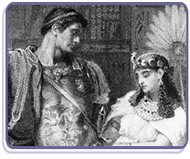
Anthony claims, “You take me in too dolorous a sense, / For I spake to you for your comfort” (IV.ii.39-40). He puts on a cheerier disposition at this criticism of his oversentimentality from Enobarbus, but says also, “Let’s to supper, come, / And drown consideration” (IV.ii.45-46).
SCENE iii
After a nighttime changing of the guard, nervous soldiers hear oboes. (These are played in the cellarage, underneath the stage, to represent supernatural sounds.) The men take this to be a sign or ill omen that Anthony’s god Hercules is abandoning him. The last line of the scene is interesting: “Content. ‘Tis strange” (IV.iii.30).
SCENE iv
The scene opens with Anthony crying, “Eros, mine armor, Eros!” (IV.iv.1) — an interesting implication to a companion soldier’s name. Cleopatra wants Anthony to sleep longer, but he refuses. With comical incompetence, Cleopatra tries to help arm Anthony. He is optimistic: “This morning, like the spirit of a youth / That means to be of note, begins betimes” (IV.iv.26-27) — a lovely poetic sentiment, but one that would refer better to the younger Caesar! Off to the famous Battle of Actium, An armed Anthony bids a hearty farewell to Cleopatra, referring to himself as a man of steel” (IV.iv.33), indicating that Shakespeare prophetically anticipated Superman. Cleopatra retires to her chamber.
SCENE v
A soldier reports to Anthony that Enobarbus has deserted to Caesar’s camp. Anthony laments this: “O, my fortunes have / Corrupted honest men! Dispatch. — Enobarbus!” (IV.v.16-17). But Anthony has ordered that Enobarbus’ belongings be sent to him with best wishes. What a guy!
In Oxfordian application, the elder Ogburns have focused attention on the case of Thomas Nashe (1567-1601), supposedly an “irrepressible friend and devoted protégé” of the Earl of Oxford (Dorothy Ogburn 565). In 1597 Nashe co-wrote with Ben Jonson a play titled The Isle of Dogs, a satirical comedy whose title partly refers to a swampy location on the Thames across from the royal palace at Greenwich where the Privy Council met and where river sewage accumulated. The play was declared “lewd,” seditious, and full of “slanderous matter.” It was seized by the authorities and all copies were destroyed. Jonson was imprisoned while Nashe fled to the continent. Soon a commission of the Privy Council sought, unsuccessfully, to have all playhouses “plucked down.” We do not know what the seditious material was, but there are hints that the Queen herself may have been satirized: Meres alludes to a Diana myth in Palladis Tamia (1598): “As Actaeon was worried by his own hounds, so is Tom Nashe of his Ile of Dogs.” Nashe may also have been too reckless and revealing about the theatrical doings and/or the identity of the Earl of Oxford, jeopardizing Oxford’s already precarious position and the survival of his own subtler but revealing “Shakespeare” works. Dorothy Ogburn speculates, “The earl himself was deeply saddened by this defection on the part of the colleague he had evidently loved best of all. He has given us the situation, the grief tempered by magnanimity, at the loss of his favorite follower, in Antony’s attitude upon the defection of his best general, Enobarbus” (Dorothy Ogburn 565-566; see also Ogburn and Ogburn 1168).
SCENE vi
Caesar wants Anthony taken alive and commands that Anthony’s deserters be placed in the vanguard (a military psychological strategy). Butchering Anthony will bring in a “time of universal peace” (IV.vi.5); alas, he’s not too wrong since Octavius Caesar, eventually “Augustus,” will bring to Rome, at least as a propagandistic motto, the “Pax Romana.”
Augustus was responsible for banishing Ovid, Shakespeare’s favorite Roman poet, so there is recognition on the playwright’s part that crafted state propaganda defines the official historical record. Add to this to the awareness that Jesus was born during the same Roman reign, and we can appreciate that Shakespeare recognized the suffering of poets and prophets at the hands of politicians. The Elizabethan Period enjoys the same glowing reputation as the Roman Empire’s Pax Romana; and history repeats itself. Like Ovid, Oxford was, at least temporarily, banished; and he was eliminated, at least from the relevant records concerning the truth of his value.
Enobarbus notes that most of Anthony’s deserters are faring poorly — Alexas was hanged and Canidius and the rest are not really trusted. When Enobarbus finds out that Anthony has sent him his treasures, he is heartbroken: “I am alone the villain of the earth…. / This blows my heart” (IV.vi.30, 34). He would rather die in a ditch now than fight against noble Anthony: “the foul’st best fits / My latter part of life” (IV.iv.38-39).
SCENE vii
The battle is going well for Anthony, and he encourages his men to continue snatching up the enemy like hares. A wounded Scarus (a good soldier of the faithful dog variety, and a name not found in Plutarch) boldly announces: “I had a wound here that was like a T, / But now ’tis made an H…./ We’ll beat ’em into bench-holes [toilets]. I have yet / Room for six scotches [cuts] more” (IV.vii.7-10).
Either an additional cut across a T-shaped wound has made a sideways H (the letter “aitch,” with a pun on the Elizabethan sound-alike “ache”), or a loop has been added to a t-shaped wound in secretary hand, making an h-like appearance. But a T-H ligature, one version of which recurs several times in the Shakspere gravestone poem, can also look like the Triple Tau Crosses intersected, bringing us to esoteric pre-Masonic knowledge and — get over it — coding. (Alan Green explains the significance in The Holy Trinity Solution.) The “t” and “h” can also represent the zodiac symbol of Saturn, and, when rotated, as Jupiter, looking like a 24 ligature. Since an arbitrary 6 appears within a few lines — With Scar-boy referring to 6 more cuts, or “six scotches” (10) — we have another instance of the recurring 624.
SCENE viii
It nears the end of a good day and Anthony tells his men, “you have all shown Hectors” (IV.viii.7). He has Cleopatra give her hand to Scarus to kiss, as he fought especially well. She promises him an “armor all of gold” (IV.viii.27).
In January 1581, Oxford presented himself in a tournament as the Knight of the Tree of the Sun. “From forth this Tent came the noble Earle of Oxenford in rich gilt Armour, and sate down vnder a great high Bay-tree, the whole stocke, branches and leaues whereof, were all gilded ouer, that nothing but Gold could be discerned.”
Anthony boldly anticipates success tomorrow.
SCENE ix
Octavius’ sentry and the watch (omitted from the BBC film production) overhear Enobarbus apostrophize to the moon, to the “sovereign mistress of true melancholy” (IV.ix.14), and to his repentance: “That life, a very rebel to my will, / May hang no longer on me” (IV.ix.16-17). He has probably inflicted wounds upon himself, and he declares,
Oh Anthony,
Nobler than my revolt is infamous,
Forgive me in thine own particular,
But let the world rank me in register
A master-leaver and a fugitive.
Oh Anthony! Oh Anthony!
(IV.ix.20-25)
Enobarbus dies. The watchmen are slow to grasp this fact. The cause? Completely ambiguous. One soldier says, “He may recover yet” (IV.ix.36), but the Sentry just declared him dead (IV.ix.32)! This seems to be the first in a series of mis-reported deaths.
The rather nice irony here is that Shakespeare completely made up a character for the name Enobarbus, so any talk of fame or infamy — e.g., “he is of note” (IV.ix.35) — reminds us that no one ever really heard of him before. Shakespeare seems to plunge into the issues surrounding this notion in Troilus and Cressida, which I’m sure he wrote after this play, not the other way around. (The hearty food imagery in this play, for example, becomes excess in Twelfth Night, and then rot imagery in Troilus and Cressida.) Enobarbus considers being “upon record” (IV.ix.9); earning or receiving one’s place in the record is a recurring concern of many characters throughout the play and of the officially erased Earl of Oxford.
SCENE x
Anthony has kicked butt on land and now notes to Scarus that Octavius is preparing for sea battle. Anthony will fight him anywhere. (The scene is 9 lines long.)
SCENE xi
Caesar commands that the forces hold their own on land. His sea preparations are a ruse to draw off Anthony’s best men. (The scene is 4 lines long.)
SCENE xii
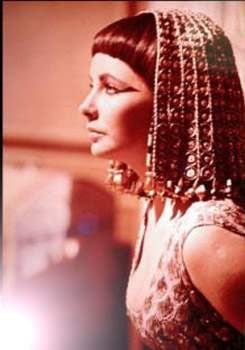
Anthony and Scarus lament that the sea battle is lost. The fleet has surrendered, the land battle is quickly over, and Anthony somehow blames Cleopatra, “This foul Egyptian,” “Triple-turn’d whore!” (IV.xii.10, 13) — that is, from Julius Caesar to Gnaeus Pompey, then to Anthony, and now to Octavius Caesar. Anthony bids good-bye to his better fortunes. Anthony considered Cleopatra his “crownet” (IV.xii.27), the reward that crowned his achievements. The “crownet” or “coronet” is a crown for lesser nobility, such as for a count (or an earl). Casca makes the distinction in Julius Caesar (1.2.237ff).
Cleopatra enters to Anthony’s threats:
Vanish, or I shall give thee thy deserving,
And blemish Caesar’s triumph. Let him take thee
And hoist thee up to the surrounding plebians!
Follow his chariot, like the greatest spot
Of all thy sex; most monster-like, be shown
For poor’st diminutives, for dolts, and let
Patient Octavia plough thy visage up
With her prepared nails. (IV.xii.32-39)
Cleopatra quickly leaves. Anthony is extreme: “one death / Might have prevented many” (IV.xii.41-42). “The shirt of Nessus is upon me” (IV.xii.43), he claims, referring to Hercules’ torment and death. He rants: “The witch shall die. / To the young Roman boy she hath sold me, and I fall / Under this plot. She dies for ‘t” (IV.xii.47-49).
SCENE viii
Cleopatra tells her ladies that Anthony is mad. Charmian recommends that Cleopatra go to her monument (or tomb) and send word to Anthony that she is dead. Cleopatra thinks this a workable scheme and adds that her last word was his name. The two lovers are misjudging each other’s motives now. And how well does fake death typically work out in Shakespeare?
Anthony and Cleopatra may be seen as a “monument” to the Elizabeth and Oxford relationship. Indeed the entire Shakespeare canon may be a kind of immortalizing monument to Elizabeth.
SCENE xiv
Anthony has been dismantled, like Osiris (Bloom 550). He asks Eros if he can see him, as he feels he has become a cloud or shadow of his former self. Then Mardian reports Cleopatra’s death. Anthony mourns that “the torch is out” (IV.xiv.46) and longs to join her, reconciled, in the hereafter. He calls back Eros and appeals to Eros’ duty to slay him “when I should see behind me / Th’ inevitable prosecution of / Disgrace and horror” (IV.xiv.64-66), “for with a wound I must be cured” (IV.xiv.78).
This paradoxical idea occurs repeatedly to the poet probably, as Beauclerk asserts, because “The spear is also strongly associated with redemption and restoration. The spear of the Grail King [or Fisher King] both wounds and heals; with it he was pierced and with it redeemed. Shakespeare performs the same alchemy with his satirical pen (as Jaques says in As You Like It, ‘And they that are most galled with my folly, / They most must laugh’). In Henry VI, Part 2, the Duke of York reminds us that the spear of Achilles was imbued with this same power of wounding and healing [5.1.99-101]” (Beauclerk 24).
Anthony expects Eros to kill him, but Eros bids farewell and kills himself instead: “Thus I do escape the sorrow / Of Anthony’s death” (IV.xiv.94-95). Anthony is impressed: “Thrice-nobler than myself!” (IV.xiv.95). Anthony considers his own “nobleness in record” (IV.xiv.99) — a respected place in the history. So he too, like Enobarbus (IV.ix.21) and other characters, has this concern.
He now needs to run into his own death “As to a lover’s bed” (IV.xiv.101). He falls on his own sword, but botches the suicide attempt.
Guards enter and one laments, “The star is fallen” (IV.xiv.107). The five-pointed star with straight-sided rays is called a mullet. It served as a heraldic emblem for the de Vere family. The falling star alludes to an apocalyptic moment in the Book of Revelation: “The third angel blew his trumpet, and a great star fell from heaven, blazing like a torch, and it fell on a third of the rivers and on the springs of water. And the name of the star is called Wormwood” (8:10-11). “Ver” is the French word and Latin etymological root of “worm”; see below (V.ii.242). So, nearly, Anthony’s real designation is Ver.
Soldiers enter and Anthony asks, “Let him that loves me strike me dead” (IV.xiv.108). “Not I,” “Nor I” (IV.xiv.109-110), are the responses. Diomed(es) enters (see? Troilus and Cressida is on Shakespeare’s mind), and Anthony begs for death, but again is denied. Cleopatra sent Diomed, sensing that her scheme to purge his rage might backfire, as it obviously has. Anthony asks to be carried to her.
SCENE xv
Cleopatra and her maids are somehow situated aloft at her tomb. She asks about Anthony and is told, “His death’s upon him, but not dead” (IV.xv.7). Anthony is brought in and Cleopatra exclaims, “none but Anthony / Should conquer Anthony” (IV.xv.17-18). They pronounce tributes to each other and attempt is made to hoist up Anthony. He has a difficult time getting a word in edgewise given her histrionics, but he advises her to seek Octavius’ mercy and trust only Proculeius. She refuses: “Shall I abide / In this dull world, which in thy absence is / No better than a sty?” (IV.xv.61-63). Anthony’s last words are: “I can no more” (IV.xv.60). Continuing the religious undertones to Anthony’s death, Rosenberg visualizes the tableau here as a kind of Pietà (385).
No stage direction such as Anthony dies appears in the First Folio.
With Anthony dead, Cleopatra laments, “The crown o’ th’ earth doth melt” (IV.xv.64), “And there is nothing left remarkable / Beneath the visiting moon” (IV.xv.68-69). She swoons, and her ladies think she too is dead; but she comes to, and ends the act with a promise to follow his example: “Come, we have no friend / But resolution and the briefest end” (IV.xv.90-91).
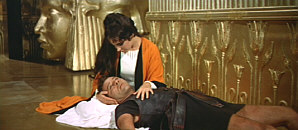
Goddard says:
from the moment when the dying Antony is lifted into her monument and she finds no word of reproach on his lips for what she has done, scales seem to drop from her eyes, and never from then on does she waver in her undeviating resolution to join him in death. What looks like hesitation and toying with the thought of life is but deception utilized with the highest art to make certain that her determination to die is not thwarted. The fact is that the new Cleopatra, with all the histrionic devices of the old Cleopatra at her command, acts so consummately in these last hours of her life that she deceives not only Octavius Caesar but full half the readers of the play. (Goddard, II 199)
But that’s still to come in the final act.
Anthony and Cleopatra, Act by Act
Anthony and Cleopatra Introduction
Anthony and Cleopatra Act IV